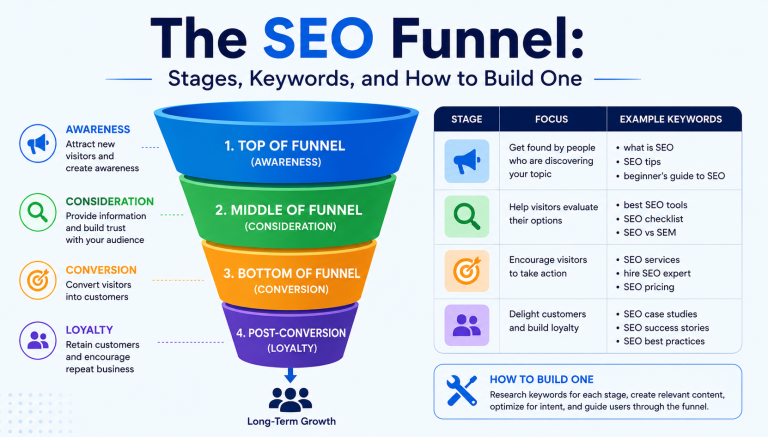
Most SEO advice obsesses over one thing: rankings. But a top ranking for the wrong keyword, aimed at someone who is nowhere near ready to buy, does very little for your business. The fix is to stop thinking about keywords as a flat list and start thinking about them as a journey. That journey is the SEO funnel.
An SEO funnel is a framework that maps your keywords and content to each stage of the buyer’s journey, from the first curious search to the final decision to buy. It makes sure you attract the right people at the top, guide them through the middle, and convert them at the bottom, instead of chasing traffic that never turns into revenue. This guide breaks down the stages, gives you a complete keyword map you can copy, and shows you how to build a funnel step by step.
What Is an SEO Funnel?
An SEO funnel is the search version of the classic marketing funnel. It organizes your organic strategy around where a person is in their decision process, then matches the right keyword, content type, and call to action to each stage. You will sometimes see the same idea called a funnel in SEO, and larger sites often run several SEO funnels at once, one for each product or service they sell.
The word funnel captures the shape of it. Many people enter at the top with broad, curious questions, fewer move to the middle as they compare options, and a smaller, high intent group reaches the bottom ready to act. A funnel built well does not just pull in traffic. It pulls in the right traffic and moves it steadily toward a conversion, which is what separates SEO that drives revenue from SEO that only drives pageviews.
SEO Funnel vs. Traditional Sales Funnel
They are close cousins, and this is the difference searchers most often ask about. A traditional sales or marketing funnel describes the stages a customer passes through across every channel, such as ads, email, and sales calls. An SEO funnel is that same journey seen specifically through the lens of organic search: the keywords people type, the intent behind them, and the content that meets them at each stage.
Put simply, the sales funnel is the whole journey, and the SEO funnel is the part of it you win with search. The stages are the same. What changes is that your levers are keywords, content, and rankings rather than ad spend or outbound calls. In that sense, building a sales funnel for SEO means trading paid reach for content that earns each stage organically.
The Stages of the SEO Funnel
The SEO funnel has three core stages. These SEO funnel stages are usually labeled top, middle, and bottom of funnel, which map onto awareness, consideration, and decision. A fourth stage, retention, keeps customers after they convert. Here is what each one means and how to serve it.
Top of Funnel (TOFU): Awareness
At the top, people have a problem or a question but do not yet know your brand or even the solutions available. Their searches are broad and informational, such as “what is SEO,” “why is my website not getting traffic,” or “how to improve Google rankings.” Your job here is not to sell. It is to be helpful and get discovered. Serve this stage with blog posts, how to guides, explainer videos, and infographics, and ask only for a small next step, such as reading another article or subscribing. The metric that matters is reach: impressions, rankings, and new organic visitors.
Middle of Funnel (MOFU): Consideration
In the middle, people understand their problem and are weighing options. Their searches turn comparative and commercial, such as “best SEO tools,” “SEO agency vs freelancer,” or “how to choose an SEO company.” This is where you show why your approach is the right one. Comparison posts, case studies, detailed content marketing assets, webinars, and service pages all work well. The call to action steps up: book a call, start a trial, or download a deeper resource. Measure engaged sessions, email signups, time on page, and return visits.
Bottom of Funnel (BOFU): Decision
At the bottom, the searcher is ready to act and is choosing who to buy from. The keywords are transactional and high intent, such as “SEO agency pricing,” “hire an SEO consultant,” or “SEO services in [city].” These searches are low in volume but extremely valuable. Serve them with service and pricing pages, testimonials, and a clear offer like a free audit or consultation. The call to action is direct: request a quote, book a demo, or get in touch. The metric is conversions, and a healthy bottom of funnel page often converts at 1 to 5 percent.
Retention and Advocacy
The funnel does not end at the sale. Existing customers search too, for help articles, how to guides, and updates, and keeping them happy turns them into repeat buyers and referrers. Support content, newsletters, and branded searches all live here. The metrics are repeat visits, branded search volume, and referrals.
The Complete SEO Funnel Map
Here is the whole funnel on one page: the intent, the kind of keywords, the content to create, and the metric to watch at every stage. This is the map to build your strategy around.
| Stage | Searcher intent | Example keywords | Content to create | Primary KPI |
|---|---|---|---|---|
| TOFU Awareness | Informational. Learning about a problem. | what is, how to, why, guide, tips | Blog posts, guides, videos, infographics | Impressions, rankings, organic traffic |
| MOFU Consideration | Commercial. Comparing options. | best, top, vs, review, alternatives | Comparisons, case studies, service pages | Engaged sessions, email signups |
| BOFU Decision | Transactional. Ready to buy. | pricing, cost, hire, near me, buy, [city] | Pricing pages, offers, testimonials | Conversions, leads (1 to 5 percent) |
| Retention | Support. Getting more value. | how to use, help, branded queries | Help docs, newsletters, updates | Repeat visits, referrals, branded search |
How to Build an SEO Funnel Step by Step
Building a funnel is really the work of organizing your keywords and content by intent, then connecting them. Here is the workflow.
- Define your core topics. Start from what you sell and the problems it solves, so every stage ties back to a real business outcome.
- Research keywords across all three stages. For each topic, gather broad informational terms, comparative commercial terms, and transactional buying terms. You need keywords for the whole journey, not just the top.
- Verify intent by reading the results page. Search each keyword and look at what already ranks. If Google shows guides, it is a top of funnel term. If it shows product and pricing pages, it is bottom of funnel. The results page tells you the true intent better than volume ever will.
- Map every keyword to a stage in a spreadsheet. This is your funnel map. Tag each keyword TOFU, MOFU, or BOFU, and note the content type it needs.
- Create or optimize content for each stage. Fill the gaps. Most sites are heavy at the top and thin at the bottom, so pay special attention to the commercial and transactional pages that actually convert.
- Connect the stages with internal links. Link your top of funnel guides to the middle and bottom pages they naturally lead to, so a reader who arrived curious can move toward a decision. Strong on page optimization and internal linking are what turn separate pages into a funnel.
- Measure and iterate. Track the stage specific metrics below, find where people drop off, and fix the weakest stage first.
How to Map Keywords to Each Funnel Stage
The single most important principle is this: map by intent, not by search volume. A high volume keyword at the top of the funnel brings a crowd that is not ready to buy, while a low volume bottom of funnel term can be worth far more per visit. Read the search results for each keyword and let the pages Google already rewards tell you which stage it belongs to. Group your keywords into topic clusters, with a broad pillar page at the top and specific supporting pages beneath it, and the funnel structure builds itself.
Here is how one topic moves through the funnel. Imagine a company that sells accounting software. At the top, someone searches “how to manage small business finances,” a broad informational query, so the company publishes a helpful guide. Weeks later that same person searches “best accounting software for small business,” a comparison query, so a feature roundup or comparison page meets them in the middle. Finally they search “accounting software pricing” or a direct “brand versus competitor” query, so a pricing page or comparison closes the deal at the bottom. One person, three searches, three pages, each built for exactly where they were in the journey.
Internal Linking: Moving Visitors Down the Funnel
A funnel is only a funnel if the stages are connected, and internal links are what connect them. They turn a set of separate pages into a path a visitor can actually follow. Without them, someone who lands on a top of funnel guide has no obvious way to reach the page that would sell to them, so they read, leave, and never come back.
The rule is simple: every page should link to the logical next step down the funnel. A top of funnel guide links to a relevant middle of funnel comparison, and that comparison links to the bottom of funnel service or pricing page. Use descriptive anchor text that tells the reader where the link leads, and keep the path short, ideally no more than a click or two from your most popular guides to a page that converts. Done well, internal linking quietly guides a curious first time reader toward becoming a customer, which is the entire point of the funnel.
Measuring Your SEO Funnel: KPIs by Stage
One overall traffic number hides where a funnel is working and where it leaks. Measure each stage on its own terms.
- Top of funnel: impressions, keyword rankings, organic traffic, and new users. Success here is reach.
- Middle of funnel: engaged sessions, time on page, email signups, and returning visitors. Success here is interest and capture.
- Bottom of funnel: conversions, leads, and conversion rate. Success here is revenue, and this is the stage to protect most fiercely.
- Retention: repeat visits, branded search volume, and referrals. Success here is loyalty.
Google Search Console and Google Analytics cover most of this for free, and reading them stage by stage shows you exactly where to focus next.
How to Balance Content Across the Funnel
A common question is how much content each stage should get. A widely used starting point is roughly half your content at the top of the funnel, about a third in the middle, and the remaining fifth at the bottom. The top needs the most because awareness content is where you build reach and topical authority, while the bottom needs fewer pages, but each one is far more valuable because it converts.
Treat that split as a guide, not a rule. The right balance depends on your business and, more importantly, on where your funnel is currently weakest. If you already have plenty of traffic but few conversions, the answer is not more blog posts, it is more middle and bottom of funnel pages. Audit what you have, find the thin stage, and build there first rather than adding to the stage that is already strong.
Common SEO Funnel Mistakes
Most funnels leak in the same few places. Watch for these.
- An all top of funnel strategy. Publishing only informational blog posts brings traffic that never converts. You need middle and bottom of funnel pages too.
- Chasing volume over intent. Ranking for a big keyword that does not match your offer is a vanity win.
- No internal links between stages. If your guides do not point toward your service pages, visitors have no path down the funnel.
- Ignoring the bottom of the funnel. Transactional pages are low volume, so they get neglected, yet they produce most of the revenue.
- Measuring only total traffic. Without stage level metrics, you cannot see where people drop off.
The SEO Funnel in the Age of AI Search
AI Overviews and tools like ChatGPT are changing the top of the funnel most of all. Broad informational questions are increasingly answered directly by AI, so some awareness stage clicks are disappearing. That does not break the funnel, it raises the value of the middle and bottom, where buyers still click through to compare and decide.
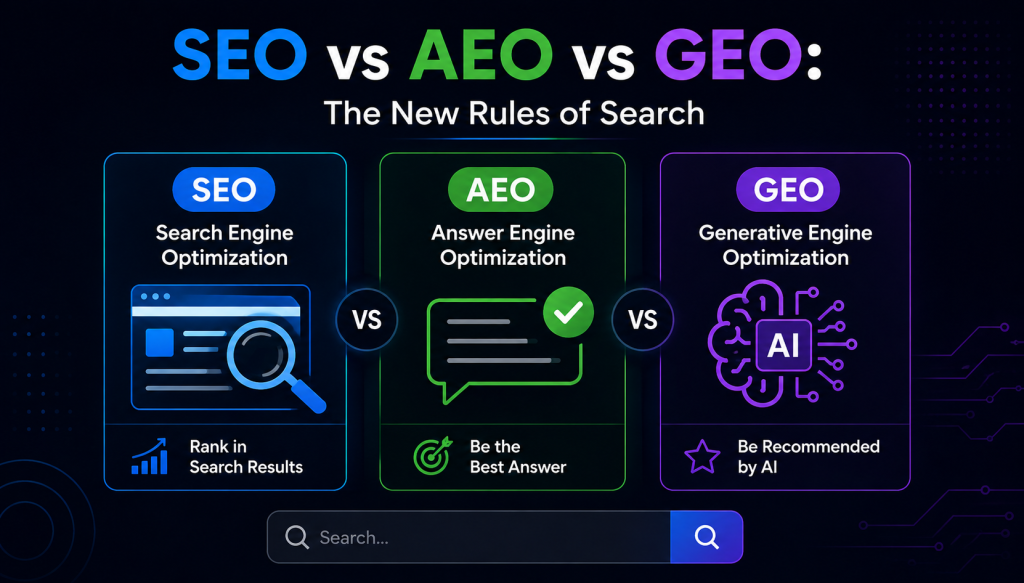
The response is to keep earning visibility at the top through answer engine and generative engine optimization, so you are the source the AI cites, while investing harder in the commercial and transactional pages that convert. If you want to understand that shift in depth, see our guide to SEO vs AEO vs GEO.
The Bottom Line
An SEO funnel turns a scattered pile of keywords into a system. By matching intent, content, and calls to action to each stage, you attract the right people, guide them with internal links, and convert them where it counts, then measure each stage so you always know what to fix next. Build the map, fill the gaps, connect the stages, and your organic traffic starts producing customers rather than just numbers.
If you would like help building a funnel that turns search traffic into leads, our team can map your keywords, plan the content, and run the strategy for you. Get in touch for a free consultation.
Frequently Asked Questions
What are the stages of an SEO funnel?
The SEO funnel has three core stages: top of funnel (awareness), middle of funnel (consideration), and bottom of funnel (decision). A fourth stage, retention, keeps customers engaged after they convert. Each stage matches a different search intent, keyword type, and content format.
What do TOFU, MOFU, and BOFU mean?
They are shorthand for the funnel stages. TOFU is top of funnel, the awareness stage of broad informational searches. MOFU is middle of funnel, the consideration stage of comparisons and reviews. BOFU is bottom of funnel, the decision stage of transactional, ready to buy searches.
What is the difference between an SEO funnel and a sales funnel?
A sales funnel is the full customer journey across every channel. An SEO funnel is that same journey seen through organic search, mapping keywords and content to each stage. The stages are the same, but the SEO funnel focuses on the traffic you win with search rather than ads or outreach.
How do you build an SEO funnel?
Define your core topics, research keywords across all three stages, verify each keyword’s intent by reading the search results, map every keyword to a stage in a spreadsheet, create content for each stage, connect the stages with internal links, and measure each stage so you can improve the weakest one.
How do you map keywords to funnel stages?
Map by intent, not volume. Search each keyword and look at what already ranks. Guides and how to articles signal top of funnel, comparisons and reviews signal middle of funnel, and pricing or product pages signal bottom of funnel. The results page reveals the true stage.
What keywords are best for the bottom of the funnel?
Bottom of funnel keywords are transactional and high intent, often including modifiers like pricing, cost, hire, buy, near me, or a city name. They have lower search volume than informational terms but convert far better because the searcher is ready to act.
How do you measure SEO funnel performance?
Measure each stage on its own metrics. Track impressions and rankings at the top, engaged sessions and signups in the middle, and conversions and leads at the bottom. Google Search Console and Google Analytics provide most of this data for free.
What is a good content split across the funnel stages?
A common guideline is roughly half your content at the top of funnel, about a third in the middle, and the rest at the bottom. The exact split depends on your business, but the key is to avoid an all top of funnel strategy that never reaches the buying stage.
Does the SEO funnel still work with AI search?
Yes, though AI Overviews are absorbing some top of funnel clicks by answering broad questions directly. That makes the middle and bottom of the funnel more valuable, and it rewards being cited as a source in AI answers. The funnel framework still holds, the emphasis simply shifts down it.
What content works best for each funnel stage?
Top of funnel suits blog posts, how to guides, videos, and infographics that build awareness. Middle of funnel suits comparison posts, case studies, and detailed service pages that aid consideration. Bottom of funnel suits pricing pages, testimonials, and clear offers like a free audit that drive the decision to buy.
How is an SEO funnel different from a keyword funnel?
They are almost the same thing described from different angles. A keyword funnel groups keywords by intent, from informational to transactional. An SEO funnel takes that keyword grouping and adds the content, calls to action, and metrics for each stage, so it is the full strategy rather than just the keyword list.
Where do most SEO funnels leak?
The most common leak is having only top of funnel content, which brings traffic that never converts. The next is missing internal links between stages, so visitors have no path downward. Neglecting low volume bottom of funnel pages, where most conversions happen, is the third. Fix these three and most funnels perform.