Ask a question today and the answer might arrive in three completely different ways. Google might show you ten blue links. It might show a single boxed answer at the top before any link. Or you might skip Google entirely, ask ChatGPT or Perplexity, and get a written answer that name checks a handful of brands and never shows a traditional result at all.
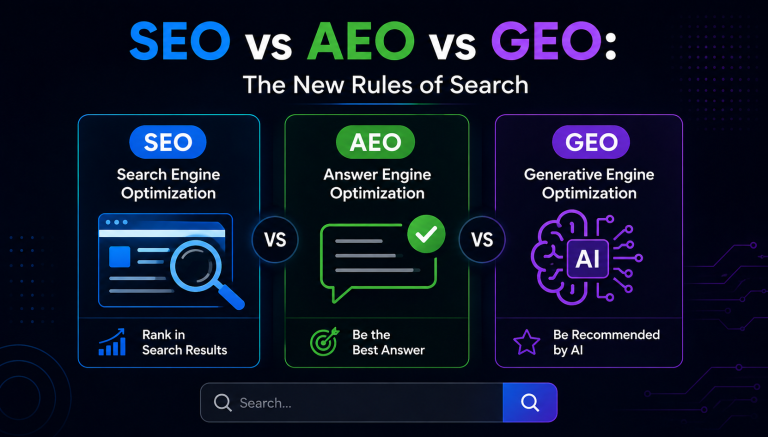
Each of those surfaces is won in a different way, and the industry has given each its own acronym: SEO, AEO, and GEO. Add the two you will also see thrown around, AIO and SXO, and it is easy to feel like everyone is inventing letters to sound clever. They are not. Each term points at a real and separate place your customers now look for answers. This guide defines all of them in plain language, compares them side by side, and gives you a practical way to decide where to spend your effort.
| Discipline | Goal | Where it shows up | Main metric |
|---|---|---|---|
| SEO | Rank in the results | Google and Bing blue links | Rankings and organic traffic |
| AEO | Be the answer | Featured snippets, People Also Ask, voice, AI Overviews | Answer and snippet share |
| GEO | Get cited by name | ChatGPT, Gemini, Perplexity, Copilot | AI citations and share of voice |
Why Search Is Splitting Into SEO, AEO, and GEO
The split is happening because the way people get answers has changed faster than the label “SEO” could keep up. Three shifts drove it.
First, Google stopped being only a list of links. Featured snippets, People Also Ask boxes, and now AI Overviews often answer the question on the results page itself, so a visitor gets what they need without clicking anything. Optimizing to be that on page answer is a different job from optimizing to rank below it.
Second, a whole new category of answer engine arrived. Hundreds of millions of people now ask ChatGPT, Gemini, Perplexity, and Copilot questions they used to type into Google. These tools do not return a ranked list. They write a synthesized answer and, increasingly, cite the sources they drew from. Being one of those cited sources is worth a great deal, and it is not something classic ranking tactics guarantee.
Third, the goal moved from clicks to influence. When an AI summarizes your category and recommends three brands by name, being one of those three shapes the buyer’s shortlist before they ever visit a website. Visibility is no longer just traffic. It is being mentioned, quoted, and trusted inside the answer itself.
The one line version: SEO gets you into the results. AEO gets you into the answer. GEO gets you into the AI’s recommendation. They are layers of the same job, not rivals.
What Is SEO?
SEO, or search engine optimization, is the practice of getting your pages to rank in traditional search results so people click through to your site. It is the foundation everything else is built on, and it is far from dead.
SEO works on a well understood model. Search engines crawl and index your pages, then rank them using signals like relevance to the query, content quality, backlinks from other sites, and technical health. You win by matching content to what people search for, earning authority, and making sure the site is fast and crawlable. If you want a refresher on the fundamentals, our guide to search engine optimization covers the full picture.
The measure of success is straightforward: keyword rankings, organic traffic, and the conversions that traffic produces. SEO is a proven, compounding channel. A page that earns strong rankings can bring in qualified visitors for years. What has changed is that ranking first is no longer the finish line, because the answer may be delivered above your link or inside a tool that never shows it.
What Is AEO (Answer Engine Optimization)?
AEO, or answer engine optimization, is the practice of structuring your content so it gets selected as the direct answer to a question. That answer might appear in a Google featured snippet, a People Also Ask box, a voice assistant reply, or a Google AI Overview.
Where SEO asks how do we rank for this query, AEO asks how do we become the answer to this query. The tactics reflect that. AEO rewards content that answers a specific question clearly and early, usually in a tight 40 to 60 word passage that an engine can lift cleanly. It leans heavily on question based headings, FAQ and How To structured data, and a clear, scannable format. Strong content marketing that is organized around real questions is the raw material AEO works with.
AEO matters because answer surfaces increasingly sit above the classic results, and because voice and mobile users expect one spoken answer rather than a page of options. The trade off is that when the engine reads your answer aloud or shows it in a box, the user may never click. That is why the metric for AEO is not only traffic but answer share: how often you are the source the engine chose.
What Is GEO (Generative Engine Optimization)?
GEO, or generative engine optimization, is the practice of getting your brand referenced, quoted, and cited by name inside the answers that generative AI tools produce. The engines here are ChatGPT, Google Gemini, Perplexity, and Microsoft Copilot, and the win is being one of the sources the model synthesizes into its reply.
The term is not marketing hype. It comes from a 2023 research paper that coined generative engine optimization and studied which content characteristics made a source more likely to be surfaced in AI answers. The findings pointed to clear, well cited, statistic rich, and authoritative content rather than keyword tricks.
GEO overlaps with SEO but is not identical. Generative engines pull from the open web, from their training data, and from live retrieval, and they favor sources that are credible, frequently mentioned across the web, and easy to extract facts from. Getting cited depends on genuine authority signals: being referenced by other trusted sites, published on a technically sound domain, and covered in the places these models read, such as industry publications and well moderated communities. A healthy technical SEO base still matters here, because a model cannot cite a page it cannot reliably crawl. The metric is new though: instead of rankings, you track how often, and how favorably, AI tools mention you.
What About AIO and SXO?
Two more acronyms show up in this conversation, and both are worth pinning down because the industry uses them loosely.
AIO, and why people mean two different things by it
Most people use AIO to mean AI Optimization, an umbrella term for the whole effort of getting seen across AI powered search, SEO plus AEO plus GEO combined. A minority use AIO to mean AI Overview optimization, meaning the specific Google SERP feature. When you see AIO, check which one the writer intends. In this guide we treat AIO as the umbrella and call the Google feature by its name, AI Overviews.
SXO, the layer almost everyone forgets
SXO, or search experience optimization, blends SEO with user experience and conversion. It is the reminder that being found is only half the job. Once someone lands on your page, the speed, clarity, trust signals, and ease of taking the next step decide whether that visit becomes a lead. You can win every acronym above and still lose the customer at a slow, confusing page. Good on page optimization is where SXO and SEO meet.
SEO vs AEO vs GEO vs AIO vs SXO: The Full Comparison
Here is every discipline side by side, so the differences and overlaps are easy to see at a glance.
| Term | Focus | Target surface | How you win | Key metric |
|---|---|---|---|---|
| SEO | Ranking pages | Google and Bing results | Keywords, content, links, technical health | Rankings, organic traffic |
| AEO | Being the answer | Snippets, PAA, voice, AI Overviews | Concise answers, FAQ and How To schema | Answer and snippet share |
| GEO | Being cited by AI | ChatGPT, Gemini, Perplexity, Copilot | Authority, citations, extractable facts | AI mentions, share of voice |
| AIO | The whole AI search effort | All of the above | SEO plus AEO plus GEO together | Combined visibility |
| SXO | Experience after the click | Your own pages | Speed, clarity, trust, conversion path | Engagement, conversion rate |
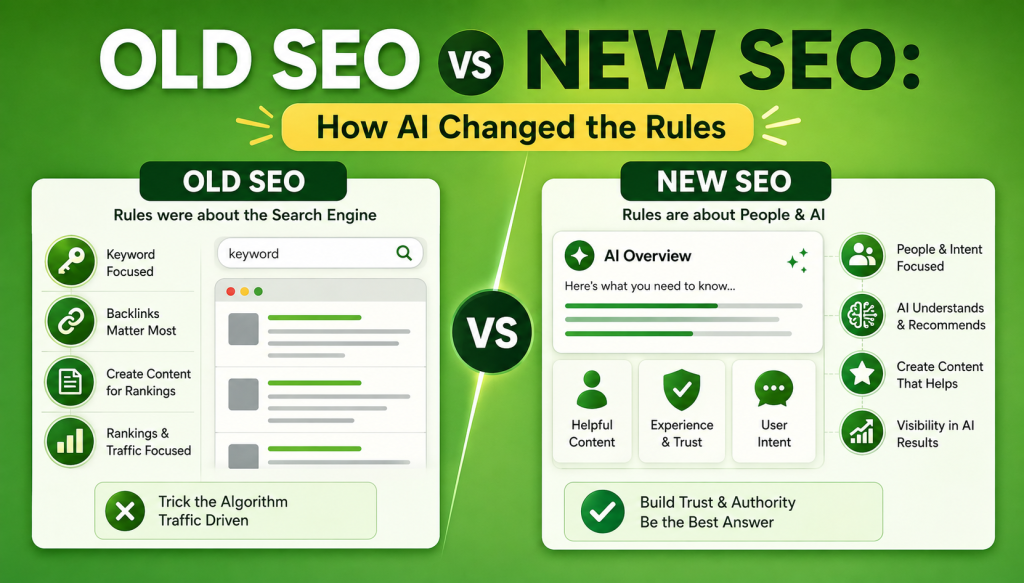
Old SEO vs New SEO
Step back from the acronyms and the shift is really a change of mindset. Old SEO asked one question: how do we rank? New SEO asks a broader one: how do we become the answer that gets found, quoted, and chosen, wherever the customer is looking?
| Old SEO | New SEO | |
|---|---|---|
| Goal | Rank on page one of Google | Be retrieved and cited across Google and AI |
| Winning move | Keywords, volume, any backlink | Genuine authority, clear answers, entity trust |
| Success looks like | Clicks and rankings | Mentions, citations, trust, then conversions |
| Risk | One algorithm update wipes traffic | Visibility spread across many surfaces |
The old playbook is not worthless. Keyword research, quality content, and strong links still power everything. But thin pages built only for volume, and links earned only for the sake of a count, do little in a world where a model is judging whether you are a credible source worth quoting. The goal has moved from how do I rank to how do I become the trusted answer.
Do They Replace Each Other?
No, and this is the most important point to get right. SEO, AEO, and GEO are not three strategies you choose between. They are three surfaces served by one strong content asset.
Consider a single, genuinely useful guide on a topic your customers care about. Structured well, it can rank in Google (SEO), get its clearest passage lifted into a featured snippet or AI Overview (AEO), and be cited by name when someone asks ChatGPT about the topic (GEO). One piece of work, three surfaces. That is why the smartest approach is not to pick a lane but to build content that is quality first, clearly structured, and demonstrably credible, so it can compete everywhere at once.
Which Should Your Business Focus On First?
Everyone says do all three. True, but not helpful if you have a limited budget and have to start somewhere. Use this simple framework to decide where to put the first dollar.
| If you are | Start with | Because |
|---|---|---|
| New, with little organic presence | SEO | You need the authority and indexed content that AEO and GEO are built on. There is no shortcut around the foundation. |
| A local or service business | AEO | Your customers ask direct, high intent questions on mobile and voice. Being the boxed answer wins the enquiry. |
| In a considered, research heavy category | GEO | Buyers are asking AI tools to compare options. Being cited by name puts you on the shortlist before the first visit. |
| Already ranking well but converting poorly | SXO | You do not have a visibility problem, you have an experience problem. Fix the page before chasing more surfaces. |
Whatever you start with, the sequence matters more than the label. Build the SEO foundation, structure it so answer engines can extract it, and earn the authority that makes generative engines trust it. Each layer makes the next one easier.
How to Optimize for Each Surface
The practical work breaks down cleanly by surface. None of it is exotic, and most of it reinforces the others.
For traditional search (SEO)
- Map high intent keywords to the right pages and match search intent.
- Publish genuinely useful, in depth content and keep it current.
- Earn quality, relevant backlinks through link building rather than volume for its own sake.
- Keep the site fast, crawlable, and free of technical errors.
For answer surfaces (AEO)
- Answer each target question directly in the first 40 to 60 words, under a clear question heading.
- Add FAQ and How To structured data so engines can read your answers.
- Use clean formatting: short paragraphs, descriptive subheadings, tables, and lists.
- Cover the follow up questions a reader would ask next, so you own the whole cluster.
For generative engines (GEO)
- Publish clear, factual, well cited content that a model can quote with confidence.
- Build genuine authority: be referenced by other trusted sites and named in the publications and communities these models read.
- Strengthen entity signals so engines understand who you are and what you are known for.
- Make sure AI crawlers can access the content you want cited, and decide deliberately which bots to allow.
How to Measure Success
The old dashboard of rankings and clicks still matters, but it no longer tells the whole story. When your answer is read aloud or your brand is cited without a link, a traffic report shows nothing even though you influenced the buyer.
So the measurement stack is widening. Alongside rankings and organic traffic, teams now track answer and snippet share, and a new metric often called AI share of voice: how often, and how favorably, your brand appears in AI generated answers across the main tools. The goal is no longer only did they click, but were we the answer, and were we named.
The Bottom Line
SEO is not being replaced. It is being joined. Search has split into ranking on the page, becoming the answer on the page, and being cited inside the AI’s answer, and each surface is won a little differently. The businesses that will win are not the ones that bet everything on one acronym. They are the ones that build one credible, clearly structured body of content strong enough to be ranked, extracted, and cited all at once, and that measure success by influence, not just clicks.
If you want help figuring out where your site stands across these surfaces and what to fix first, our team can audit it and build the plan. Get in touch for a free consultation.
Frequently Asked Questions
What is the difference between SEO, AEO, and GEO?
SEO gets your pages to rank in traditional search results. AEO structures your content to be selected as the direct answer in snippets, voice, and AI Overviews. GEO gets your brand cited by name inside generative AI tools like ChatGPT and Perplexity. They target different surfaces of the same search journey.
Is AEO just a new name for SEO?
No. SEO aims to rank a page so people click it, while AEO aims to have your content chosen as the answer, often shown without a click. AEO builds on SEO but adds question focused formatting and structured data so answer engines can extract your content cleanly.
Is GEO replacing SEO?
No. GEO is a new layer, not a replacement. Generative engines still rely on credible, well indexed content, so strong SEO makes GEO possible. Google’s own position is that optimizing for AI search is still, at its core, optimizing for the search experience.
What is the difference between AEO and GEO?
AEO is about being the direct answer on a search results page, such as a featured snippet or AI Overview. GEO is about being referenced and cited inside a generative AI tool’s written response. AEO lives mostly on Google, GEO lives inside chat based AI engines.
What does AIO mean?
AIO is used two ways. Most people mean AI Optimization, an umbrella for getting visible across AI search, which combines SEO, AEO, and GEO. A minority use it for AI Overview optimization, the specific Google feature. Always check which meaning is intended.
What is SXO?
SXO, or search experience optimization, combines SEO with user experience and conversion. It focuses on what happens after the click: whether a fast, clear, trustworthy page turns the visitor into a lead. It is the layer that makes all your visibility actually pay off.
Which should I prioritize first, SEO, AEO, or GEO?
If you are starting out, build SEO first, because AEO and GEO depend on the authority and indexed content it creates. Local and service businesses often see fast wins from AEO, while research heavy and considered purchase categories benefit most from GEO. In every case, SEO is the foundation.
Can one page rank in Google and be cited by AI at the same time?
Yes, and that is the goal. A single, well structured, credible guide can rank in search, have its clearest passage pulled into a snippet or AI Overview, and be cited by name in ChatGPT. One quality asset can serve all three surfaces.
How do AI engines decide which sources to cite?
Generative engines favor content that is clear, factual, well cited, and authoritative, from sources that are frequently referenced across the web and easy to extract facts from. Genuine credibility and technical accessibility matter more than keyword density.
How do I measure AEO and GEO performance?
Rank tracking alone is not enough. For AEO, track how often you win snippets and answer boxes. For GEO, track AI share of voice, meaning how frequently and how favorably AI tools mention your brand. The shift is from measuring clicks to measuring citations and mentions.
Should I block or allow AI crawlers?
It is a deliberate choice. Allowing AI crawlers such as the ones used by ChatGPT and Perplexity lets your content be cited in their answers, which is the whole point of GEO. Some brands restrict them to protect content, so decide based on whether AI citations help or hurt your goals.
Is SEO dead in 2026?
No. SEO is evolving, not dying. The fundamentals of useful content, authority, and technical health now power ranking, answers, and AI citations alike. What is fading is thin, volume first content with no credibility behind it.