Every few years someone declares that SEO is dead. This time the obituary is written by AI: ChatGPT answers questions without sending a click, Google shows an AI Overview above the blue links, and buyers increasingly trust a generated answer over a page of results. So is traditional SEO finished, and is AI SEO the replacement?
The honest answer is no, and not quite. SEO is not dying; it is splitting into two connected disciplines. Traditional SEO still does most of the heavy lifting, and AI SEO adds a new layer on top of it. This guide breaks down AI SEO vs traditional SEO in plain terms: what each one is, what has actually changed, what still works exactly as before, and why the winning move in 2026 is to do both.
AI SEO vs Traditional SEO: The Short Answer
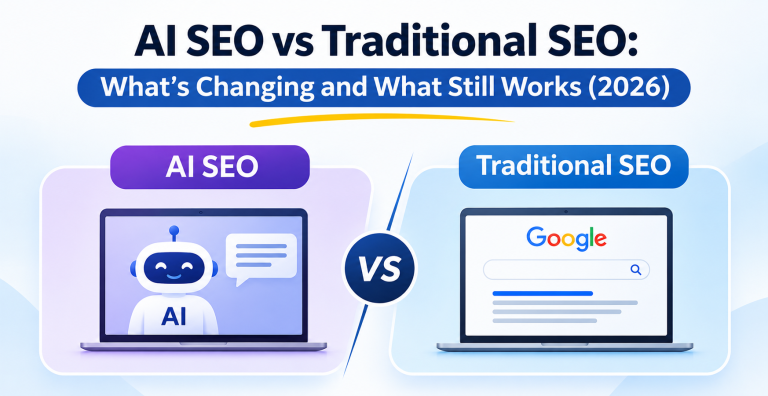
Traditional SEO is about earning rankings on the search results page so people click through to your site. AI SEO is about getting your brand recommended and cited inside AI-generated answers, on ChatGPT, Gemini, Perplexity, and Google’s AI Overviews, where there are no ten blue links to climb.
They are not rivals. AI engines can only cite content they can crawl, understand, and trust, which is exactly what good traditional SEO produces. Think of traditional SEO as the foundation and AI SEO as the new floor built on top of it.
| Traditional SEO | AI SEO | |
|---|---|---|
| Goal | Rank in the blue links | Get cited in AI answers |
| Where it shows | Search results page | ChatGPT, Gemini, Perplexity, AI Overviews |
| Main levers | Keywords, backlinks, on-page, technical | Entities, citable content, authority, structured data |
| Success metric | Rankings, clicks, organic traffic | Citation share, AI visibility, brand mentions |
| Still matters in 2026? | Yes, as the foundation | Yes, as the new layer |
What Is Traditional SEO?
Traditional SEO is the practice of optimising a website to rank higher in search engines like Google so it earns more organic clicks. It rests on three pillars that have barely changed in a decade: on-page SEO (relevant, well-structured content and keywords), off-page SEO (backlinks and authority from other sites), and technical SEO (crawlability, speed, site structure, and indexation). The payoff is a ranking position, and the behaviour it depends on is a click.
This is the discipline most businesses already know, and it is still where the majority of search value sits today.
What Is AI SEO?
AI SEO is the practice of optimising your brand and content so that AI-powered answer experiences recommend and cite you. It brings together Generative Engine Optimization (GEO), Answer Engine Optimization (AEO), and the parts of traditional SEO that feed them. Instead of competing for a ranking a user then clicks, you compete to be one of the few sources an engine names when it writes the answer itself.
The behaviour it depends on is different: often there is no click at all. The user reads the answer, sees your brand cited as a trusted source, and that mention does the work. Learning how to get cited by ChatGPT, Gemini, and Perplexity is the practical core of AI SEO.
The Key Differences That Actually Matter
Beyond the table above, three differences change how you should work.
The surface is different. Traditional SEO competes on a results page with ten links. AI SEO competes inside a single answer that names three or four sources, so the gap between being included and being invisible is far wider.
The signals are weighted differently. Traditional SEO leans heavily on keywords and backlinks. AI SEO leans more on entity clarity (does the engine understand who you are?), quotable structure (can it lift a clean passage?), and third-party consensus (does the wider web vouch for you?). Backlinks still help, but being clearly understood and widely referenced matters more.
The metric is different. In traditional SEO you track rankings, clicks, and organic traffic. In AI SEO you track citation share, how often your brand is named across a fixed set of buyer prompts versus competitors. One measures position; the other measures presence in the answer.
A Quick Example: One Query, Two Surfaces
Imagine a buyer researching “best project management tool for small teams.” In the traditional world, they type it into Google, scan the ten results plus a few ads, click two or three, and compare. Your job is to rank high enough to earn that click, so you optimise the page, build links, and fix technical issues.
In the AI world, the same buyer asks ChatGPT or Perplexity the same question and reads one answer that names three tools and briefly says why. There is no page of links to climb; there is a shortlist to be on. If your product is clearly described across the web, structured so a model can quote it, and vouched for by trusted sources, you make the shortlist. If not, you are simply absent from the conversation. Same intent, same buyer, two completely different contests, and most brands are only showing up for one of them.
What’s Changing in Search
Several shifts are real and worth planning around:
- AI Overviews sit above the links. Google now answers many queries directly at the top of the page, which pushes the classic blue links down and reduces clicks on informational searches.
- Zero-click answers are rising. More questions are resolved inside the search page or an assistant, so impressions without clicks become normal, and brand visibility inside the answer becomes its own goal.
- Entities beat keywords. Engines increasingly reason about brands, people, and topics as entities, not just strings of text, so being a clearly defined, well-connected entity matters more than exact-match phrasing.
- New engines, new crawlers. ChatGPT, Gemini, and Perplexity each read the web through their own crawlers, and allowing them in (or not) now directly affects whether you can be cited.
- Traffic patterns are shifting, not vanishing. Informational, top-of-funnel clicks are the most exposed to AI answers, while high-intent, commercial, and branded searches still convert through the classic results. The practical takeaway is to defend your money pages with traditional SEO and build AI visibility for the research questions that increasingly get answered without a click.
What Still Works (and Isn’t Going Anywhere)
Here is the part the “SEO is dead” headlines miss: most of traditional SEO still works, and AI depends on it.
- Crawlable, technically healthy sites. An engine, human or AI, can only use content it can reach, render, and parse. Technical SEO is now table stakes for both.
- Genuinely useful, well-structured content. Clear, helpful pages rank in Google and get quoted by AI for the same reason: they answer the question well.
- Authority and trust. Backlinks, brand mentions, and reputation still signal that you are worth ranking and worth citing.
- Search intent. Understanding what a searcher actually wants remains the heart of the whole craft, whether the answer appears as a link or a citation.
- Keyword and topic research. You still need to know what your audience asks; AI simply rewards answering those questions more directly.
There is one more constant worth naming: experience, expertise, authority, and trust. Content that is genuinely helpful, written by people who know the subject, and backed by a credible brand is what Google rewards and what AI engines feel safe repeating. Demonstrating real expertise is not a traditional-SEO tactic or an AI-SEO tactic; it is the thing both reward most.
In other words, the fundamentals did not die. They became the entry ticket to both games.
Do You Need Both? Yes, Here’s How They Work Together
Treating AI SEO and traditional SEO as an either/or is the mistake. They compound. Strong traditional SEO makes your content crawlable, authoritative, and well-structured, which is exactly what makes it citable by AI. AI SEO then captures the visibility that traditional rankings alone can no longer reach, as more answers happen before the click.
A practical way to think about it: traditional SEO wins you the click when there is one, and AI SEO wins you the mention when there isn’t. Skip the first and you have nothing for AI to cite; skip the second and you cede the fastest-growing part of search to competitors.
How to Adapt Your Strategy in 2026
You do not need to tear anything down. You need to extend what you already do.
- Keep your SEO foundation strong. Technical health, quality content, and authority still drive most of your results, so do not neglect them.
- Make your content citable. Lead sections with direct answers, add structure, tables, and real FAQs, and write so a model can lift a clean passage.
- Open the door to AI crawlers. Allow GPTBot, Google-Extended, PerplexityBot, and ClaudeBot unless you have a reason not to.
- Strengthen your entity. Make it unmistakable who you are, with a clear About page, consistent details, and Organization schema.
- Measure AI visibility too. Track citation share alongside rankings so you can see progress in both arenas.
None of this requires abandoning the work you have already done. If your site is technically sound and your content is genuinely helpful, you are most of the way there; the new effort is making that content easy for machines to quote, clarifying who you are as a brand, and starting to measure where you show up in AI answers. Teams that frame it as an extension rather than a rebuild move faster and waste far less.
Do these and you are not choosing between AI SEO and traditional SEO; you are building one strategy that wins in both.
Let Specialists Handle Both
Running traditional SEO and AI SEO together takes a team that understands rankings and citations. optmistic is an AI SEO company that combines GEO, AEO, and proven SEO into one strategy, so you capture clicks and citations at the same time. We have delivered results since 2016, across 220+ projects for clients worldwide, and our team is SEMrush-certified. Explore our AI SEO, GEO & AEO services or get a free AI visibility audit to see where you stand in both search and AI answers today.
Frequently Asked Questions
What is the difference between AI SEO and traditional SEO?
Traditional SEO optimises your site to rank in the search results page and earn clicks, using keywords, backlinks, on-page, and technical SEO. AI SEO optimises your brand and content to be recommended and cited inside AI-generated answers on ChatGPT, Gemini, Perplexity, and Google’s AI Overviews, using entity clarity, citable content, structured data, and third-party authority.
Is traditional SEO dead?
No. Traditional SEO is evolving, not dying. Its fundamentals, crawlable sites, quality content, authority, and search intent, are exactly what AI engines rely on to choose who to cite. Traditional SEO is now the foundation that AI SEO is built on.
Will AI replace SEO?
AI is changing how search works, but it is not removing the need for SEO. It adds a new surface, AI-generated answers, that you also have to optimise for. The skills shift toward entities, citable content, and measuring AI visibility, but the core goal, being the trusted answer to a query, is unchanged.
Which is better, AI SEO or traditional SEO?
Neither on its own. Traditional SEO wins the click when there is one; AI SEO wins the citation when the answer happens before the click. In 2026 the strongest strategy does both, because each one makes the other more effective.
Do I need to do AI SEO if my traditional SEO is already good?
Yes, and good traditional SEO gives you a head start. Crawlable, authoritative, well-structured content is already half of what AI engines need, so adding entity clarity, citable formatting, and AI-visibility tracking lets you capture AI citations without starting from scratch.