If your website is not showing up in Google when potential customers search for what you offer, the problem is almost always one of three things: the technical foundation is broken, the content is not targeted to the right keywords, or your site lacks the authority to compete. An SEO specialist is the person who diagnoses and fixes all three. Whether you are considering SEO as a career path, evaluating whether to hire an in-house specialist, or trying to understand what you should expect from an SEO professional you are already working with, this guide covers everything you need to know.
After ten years of working in SEO across markets in the US, UK, Canada, and Australia, and completing more than 220 client engagements, the answer to ‘what does an SEO specialist actually do’ is rarely what people expect. The job title understates the breadth of the work. A good SEO specialist is part analyst, part content strategist, part technical auditor, part link builder, and part client educator. This guide breaks down each of those roles clearly.
What Is an SEO Specialist?
An SEO specialist is a professional who improves the visibility of websites in organic (non-paid) search engine results. Their primary objective is to increase the volume and quality of traffic a website receives from search engines like Google, Bing, and others, by ensuring the site ranks highly for the keywords its target audience is searching for. Unlike paid advertising, where visibility stops the moment you stop spending, organic rankings built by a skilled SEO specialist generate traffic continuously and compound in value over time.
The term ‘SEO specialist’ covers a broad range of roles in practice. Some specialists focus primarily on technical SEO: site architecture, crawlability, Core Web Vitals, and structured data. Others focus on content strategy and on-page optimization. Many operate as generalists covering all three pillars of SEO: technical, on-page, and off-page. In an agency context, the SEO specialist is typically the person responsible for the complete organic search performance of a client account.
What Does an SEO Specialist Actually Do Day to Day?
The day-to-day work of an SEO specialist varies depending on the stage of an engagement, the size of the site, and the primary ranking challenges being addressed. Below is a breakdown of the core responsibilities most SEO specialists carry across a typical month.
Technical SEO Auditing and Fixes
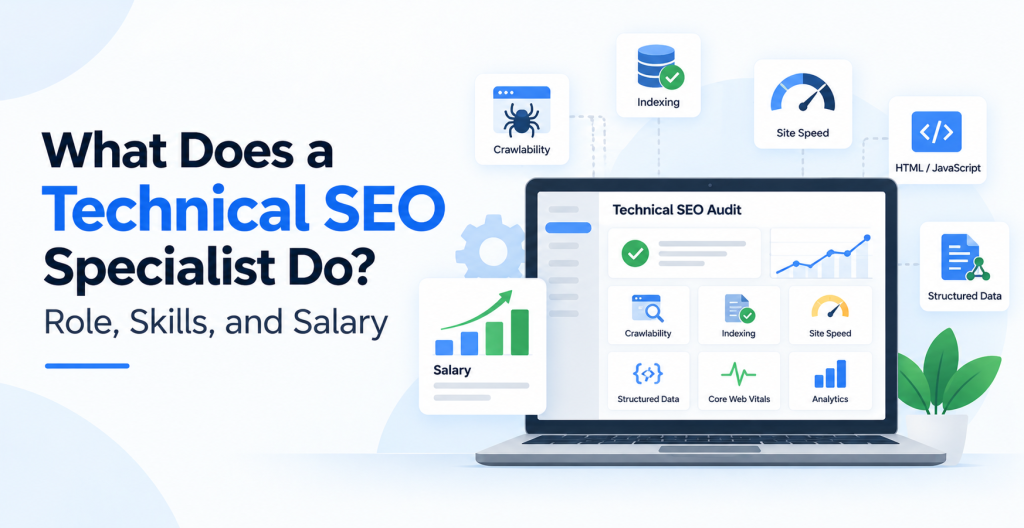
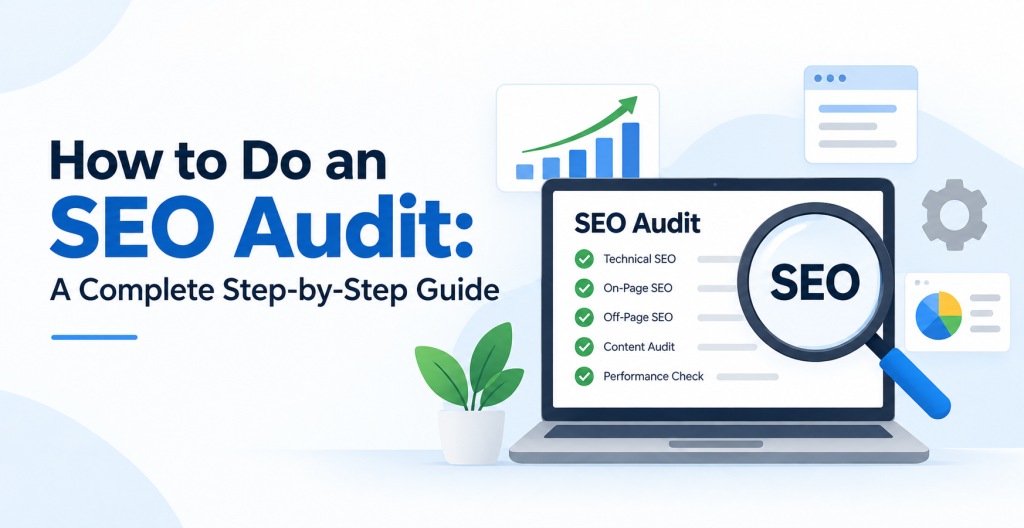
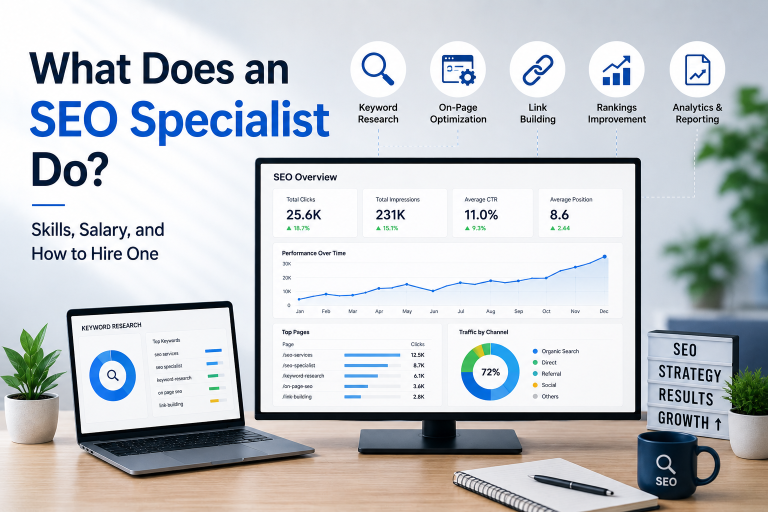
A significant proportion of SEO work happens at the technical level, before any content is written or any backlinks are built. An SEO specialist audits the site’s crawlability (can search engines access all important pages?), indexation (which pages are actually in Google’s index?), site speed and Core Web Vitals, HTTPS and redirect configuration, canonical tag setup, XML sitemap health, and structured data implementation. On most established websites, the first technical audit surfaces between 20 and 80 fixable issues that are actively limiting rankings.
Keyword Research and Content Strategy
Keyword research is not a one-time task completed at the start of an engagement. It is an ongoing process of identifying what terms the target audience uses to find products, services, and information, mapping those terms to specific pages across the website, and identifying gaps where new content needs to be created. A skilled SEO specialist uses tools like Ahrefs, Semrush, and Google Search Console to build a keyword map that covers commercial intent pages (service pages, product pages) and informational content (blog posts, guides) across the full buyer journey.
On-Page Optimization
On-page optimization is the process of ensuring each page on a website is correctly configured to rank for its target keyword. This covers title tags, meta descriptions, heading structure (H1 through H3), body content quality and depth, internal linking, image alt text, URL structure, and schema markup. An SEO specialist audits every page against these criteria, rewrites or restructures the pages most in need of improvement, and tracks the impact of changes on rankings and click-through rates using Google Search Console data.
Link Building and Off-Page Authority
Domain authority the measure of how trustworthy and credible Google considers your website, is built primarily through backlinks from other websites. An SEO specialist identifies link acquisition opportunities through competitor analysis, designs a white hat link building strategy (editorial guest posting, resource page acquisition, digital PR, broken link building), executes outreach campaigns, and monitors the growth of the site’s referring domain profile over time. Link building is the most time-intensive component of SEO work and the one most directly correlated with ranking improvements for competitive keywords.
Reporting and Analytics
A good SEO specialist does not just execute work. They measure it. Monthly reporting covers keyword ranking movements for all target pages, organic traffic trends in Google Analytics and Search Console, click-through rate changes on optimized pages, backlinks acquired with domain metrics, technical fixes completed and their impact, and the priority work plan for the following month. Reporting is also where the SEO specialist educates the client or stakeholder on what the data means and what decisions it informs.
What Skills Should an SEO Specialist Have?
If you are hiring an SEO specialist, whether as an employee or through an agency, these are the skills that separate professionals who produce results from those who produce reports. The list is not exhaustive, but each skill on it is genuinely necessary for effective SEO work in 2025.
- Technical proficiency: ability to crawl a site with Screaming Frog, read Google Search Console data, identify and fix canonical tag errors, diagnose Core Web Vitals failures, and implement JSON-LD schema. A specialist who cannot do these tasks independently is not a full-stack SEO professional.
- Keyword research depth: comfort with Ahrefs or Semrush at an intermediate to advanced level, ability to build a keyword map from scratch, and understanding of search intent differences between query types.
- Content judgment: ability to evaluate whether existing content meets the quality bar required to rank for a given keyword, and to produce or direct rewrites that address the gap. This is editorial judgment, not just technical knowledge.
- Link building methodology: specific knowledge of white hat link acquisition methods and active outreach experience. An SEO specialist who cannot explain their link building process in detail is not building links effectively.
- Analytical thinking: ability to correlate ranking changes with specific actions, identify why a page that should rank is not ranking, and diagnose algorithm update impacts. SEO is primarily a diagnostic discipline.
- Communication: ability to explain technical SEO issues to non-technical stakeholders in plain language and to justify strategy decisions with data. This matters in every agency and in-house context.
- Adaptability: Google updates its core algorithm multiple times per year and releases targeted updates (Penguin, Helpful Content, spam updates) continuously. An SEO specialist who is not actively following algorithm developments is operating on outdated knowledge.
Do You Need a Degree to Become an SEO Specialist?
No. SEO is one of the few professional disciplines where demonstrated results consistently outweigh formal qualifications in hiring decisions. Most working SEO specialists, including those at the senior level, are self-taught, having built their knowledge through a combination of online courses, industry resources (Ahrefs blog, Semrush Academy, Google Search Central documentation), and hands-on practice on their own sites or early client work. A degree in marketing, computer science, journalism, or communications is useful context but is not a prerequisite.
What does matter is a verifiable track record. When hiring an SEO specialist or evaluating an agency, ask to see specific examples of sites they have improved: the starting rankings, the actions taken, and the measurable outcome. Any experienced SEO specialist will have these examples available. If they cannot produce a single documented case study with real ranking data, that tells you more than any qualification they hold.
SEO Specialist Career Path and Salary
For those considering SEO as a career, the typical progression moves from SEO trainee or junior SEO executive at entry level, to SEO executive or specialist at mid-level, to SEO manager or senior SEO specialist with 3 to 5 years of experience, and then to SEO director, head of SEO, or independent SEO consultant at the senior level. Freelance and agency routes are equally common, many experienced SEO professionals transition to agency ownership or independent consulting after building a strong track record in employment.
On salary, entry-level SEO roles in the US typically range from $40,000 to $55,000 per year. Mid-level specialists with 2 to 4 years of experience command $55,000 to $75,000. Senior SEO specialists and managers at established agencies or in-house at larger companies typically earn $75,000 to $100,000. Independent SEO consultants and agency owners working with established client bases frequently earn above $100,000, with earnings tied directly to client results and retention rather than a fixed salary ceiling.
Should You Hire an In-House SEO Specialist or Work With an Agency?
This is the most practically important question for business owners reading this post. The honest answer depends on your budget, your site’s complexity, and how central organic search is to your revenue model. A senior in-house SEO specialist in the US costs $70,000 to $100,000 per year in salary alone, before benefits, tools (Ahrefs and Semrush together cost around $500 per month), and the management overhead that comes with any employee. For that cost, you get one generalist who covers technical SEO, content, and link building with varying depth across each discipline.
A specialist SEO agency at the same or lower total cost gives you access to a team with depth in each discipline: a technical SEO specialist who audits and fixes crawlability issues, a content strategist who handles keyword research and on-page optimization, and a link builder who manages outreach campaigns. The agency model also provides continuity, if your in-house specialist leaves, your SEO programme stops. Agency work continues regardless of internal personnel changes. For most small to mid-size businesses targeting competitive keywords, a specialist agency delivers better outcomes per dollar than a single in-house hire.
What to Expect From an SEO Specialist in the First 90 Days
The first 90 days of any serious SEO engagement should follow a clear pattern: audit, prioritize, and execute. In the first 30 days, a good SEO specialist completes a full technical audit, builds or validates the keyword map, reviews content quality across the most important pages, and produces a prioritized action plan. In days 31 to 60, the highest-impact technical fixes are implemented, the most important page rewrites are completed, and the first link building outreach campaigns are launched. By day 90, you should have measurable data, ranking movements for specific keywords, coverage improvements in Search Console, and an honest assessment of what the next quarter of work will produce.
What you should not expect in the first 90 days is significant organic traffic growth. SEO is a compounding process. The technical and on-page work done in the first three months sets the foundation that produces traffic growth in months four through twelve. Any SEO specialist who promises substantial traffic increases within 60 days is either targeting very low-competition keywords or using methods that will not hold. Ask for a realistic timeline in the initial consultation and treat vague or over-optimistic answers as a red flag.
SEO Specialist Job Description (Template)
If you are hiring, or writing your own role, here is a simple SEO specialist job description you can adapt.
Role summary. The SEO specialist improves a website’s visibility in organic search by optimizing content and technical elements, building quality links, and analyzing performance to grow traffic and leads.
Key responsibilities. Conduct keyword research, optimize on-page elements and site structure, fix technical SEO issues, plan and support content, build backlinks, and report on rankings, traffic, and conversions.
Requirements. Proven SEO experience, working knowledge of tools such as Google Analytics, Google Search Console, and a platform like Ahrefs or Semrush, a basic understanding of HTML, and strong analytical and communication skills. A degree is helpful but not essential.
Types of SEO Specialists
SEO is broad, so many specialists focus on one area.
Technical SEO specialist. Focuses on crawling, indexing, site speed, structured data, and the technical health of the site.
On-page and content SEO specialist. Focuses on keyword research, content optimization, and page structure.
Off-page SEO specialist. Focuses on link building, digital PR, and building the site’s authority.
Local SEO specialist. Focuses on Google Business Profile, local citations, and ranking in a specific city or region.
Some specialists are generalists who cover all of these, while larger teams split the work across dedicated roles.
Frequently Asked Questions
What is the difference between an SEO specialist and an SEO manager?
An SEO specialist is a hands-on practitioner who executes SEO work directly: auditing sites, optimizing pages, building links, and producing reports. An SEO manager typically oversees a team of specialists, coordinates SEO strategy across multiple accounts or departments, and communicates results to senior stakeholders. In smaller agencies and businesses, the same person may do both. The specialist role is generally more technical and execution-focused; the manager role is more strategic and administrative.
How long does it take to become an SEO specialist?
Most people develop foundational SEO competency within 6 to 12 months of focused study and hands-on practice. Reaching a level of proficiency where you can independently manage a client account and produce consistent ranking results typically takes 2 to 3 years of real-world work. Senior-level SEO expertise, the ability to diagnose complex algorithm impact scenarios, manage large-scale technical SEO projects, and lead link acquisition campaigns in competitive niches, generally takes 5 or more years of active practice across a range of site types and markets.
What tools does an SEO specialist use?
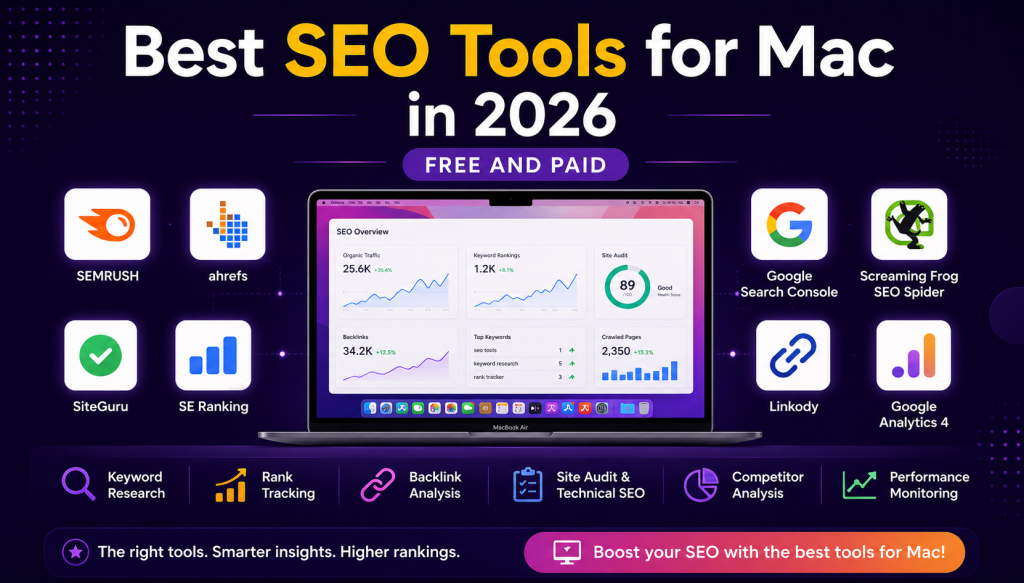
The core tool set for a professional SEO specialist includes: Ahrefs or Semrush for keyword research, competitor analysis, backlink monitoring, and site auditing; Google Search Console for indexation data, keyword performance, and Core Web Vitals monitoring; Google Analytics 4 for traffic and conversion data; Screaming Frog for detailed site crawling and technical issue identification; PageSpeed Insights for Core Web Vitals measurement; and Google’s Rich Results Test for structured data validation. Most specialists also use word processors and spreadsheets extensively for reporting and content production.
Is SEO a good career choice?
Yes, for the right kind of person. SEO offers strong long-term career prospects because organic search remains one of the highest-ROI marketing channels available, the discipline requires a combination of technical and creative skills that resists full automation, and the knowledge compounds over years of practice in a way that builds genuine, marketable expertise. The job market for experienced SEO specialists is consistently strong, and the freelance and agency routes offer income potential that scales well above typical employment salaries for those who build a strong track record.
How do I know if an SEO specialist is actually good?
Ask for documented case studies that show starting rankings, the specific actions taken, and measurable outcomes. Good SEO specialists have these readily available. Also ask them to explain their link building methodology in detail, the answer will quickly reveal whether they use legitimate white hat methods or rely on shortcuts that carry algorithmic risk. Check their own agency’s or personal website’s organic performance using a free Ahrefs or Semrush check. And look for verifiable reviews on Google, Clutch, or Upwork rather than relying solely on testimonials on their own website.
What is the difference between an SEO specialist and a digital marketing generalist?
An SEO specialist focuses exclusively or primarily on organic search performance. A digital marketing generalist covers a broader range of channels including paid advertising, social media, email marketing, and content marketing alongside SEO. For businesses where organic search is a primary growth channel, a specialist will produce better SEO results than a generalist, because the discipline rewards depth of focus and continuous specialization. For businesses with diverse marketing needs and limited budget, a generalist may be more practical as an early hire.
Can an SEO specialist help with local SEO?
Yes. Local SEO is a specific discipline within the broader SEO field, covering optimization for location-based search queries and Google Maps visibility. An SEO specialist with local experience handles Google Business Profile optimization, local citation building, NAP consistency management, local keyword targeting, and review strategy. For trades businesses, professional service firms, restaurants, and retail businesses targeting customers in a specific geographic area, local SEO is often the highest-ROI SEO investment available.
How much does it cost to hire an SEO specialist or agency?
Freelance SEO specialists typically charge between $75 and $200 per hour, or between $500 and $3,000 per month on retainer depending on the scope of work. SEO agencies generally charge between $1,000 and $5,000 per month for small to mid-size business engagements, with enterprise-level campaigns running higher. Very cheap SEO services, under $300 per month, almost always involve either a very limited scope of work or tactics that carry Google penalty risk. The relevant question is not what the service costs but what it delivers per dollar invested.
What does SEO specialist mean?
An SEO specialist is a professional who improves how well a website ranks in organic search results. The role covers keyword research, on-page and technical optimization, link building, and reporting, all aimed at growing search traffic.
What is an SEO specialist in digital marketing?
Within digital marketing, an SEO specialist owns the organic search channel. They work alongside the paid ads, social, and content teams, but their focus is earning free, long-term traffic from search engines rather than paid placements.
At Optmistic Technologies, our SEO work is handled by specialists with over 10 years of experience across competitive markets in the US, UK, Canada, and Australia. Every client engagement starts with a full site audit before any strategy is proposed. If you want to understand what an SEO specialist would find on your site and what it would take to improve your rankings, contact us for a free site audit.