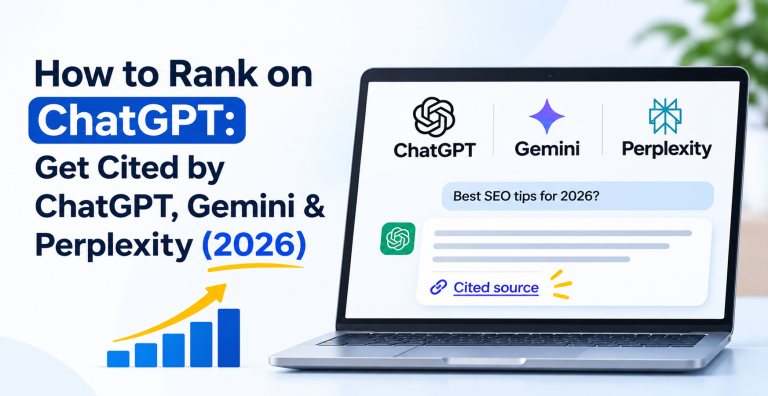
More and more of your buyers now ask an AI assistant before they ask Google. They type a question into ChatGPT, Gemini, or Perplexity, read the single answer it writes, and act on the few brands it names. If your brand is not in that answer, you are invisible to a fast-growing slice of your market, no matter how well you rank in traditional search.
This guide explains, in plain terms, how to rank on ChatGPT and get your brand cited across ChatGPT, Gemini, and Perplexity. You will learn how these engines decide who to mention, a practical 7-step playbook you can start this week, engine-specific tips, and how to check whether it is actually working.
Why Getting Cited by AI Matters Now
Traditional search hands the user ten links and lets them choose. An AI engine does the choosing for them: it reads across the web, writes one answer, and cites a handful of sources it trusts. That shift changes the game in three ways.
First, there is far less room at the top. Instead of ten blue links, there are often three or four named sources, so the gap between “cited” and “invisible” is wide. Second, being cited builds trust fast, because the user reads your brand as the answer the AI endorsed, not as one option in a list. Third, the space is still young. Most businesses have not optimised for it yet, which means there is a real first-mover advantage for brands that start now.
Getting cited by AI is the practical, day-to-day side of Generative Engine Optimization (GEO). If GEO is the strategy, ranking on ChatGPT is the execution.
How ChatGPT, Gemini & Perplexity Decide Who to Cite
These engines do not rank pages the way Google does. Most of them answer by retrieving relevant, trustworthy content and then summarising it, naming the sources they relied on. A few signals decide whether you make the cut:
- Can they reach you? If their crawlers cannot access your content, you cannot be cited. This is the single most common reason brands are missing.
- Do they understand who you are? Engines need a clear picture of your brand as an entity: what you do, your category, and how you relate to competitors.
- Is your content easy to quote? Clear, direct, well-structured answers are easy for a model to lift and attribute. Long, rambling pages are not.
- Does the rest of the web vouch for you? Mentions, reviews, and citations on trusted third-party sites teach the model to associate your name with your topic.
- Is it current and consistent? When several reliable sources agree and the information is fresh, a model is far more confident repeating it.
Get those five right and you are most of the way to being cited. The playbook below turns them into concrete actions.
Which Content Formats AI Engines Cite Most
Not every page is equally quotable, and that difference decides who gets named. Across the campaigns we run, a few formats earn citations far more often than long, unstructured prose:
- Clear definitions and “what is” explanations that state the answer in the first sentence, before any build-up.
- Comparisons and “X vs Y” breakdowns, ideally with a short table, because engines love to summarise differences cleanly.
- Step-by-step guides and checklists, which map almost perfectly onto the instructional answers assistants like to give.
- Original data, statistics, and named frameworks, which give a model something specific and attributable to cite rather than paraphrase.
- Well-formed FAQs, where each question is a real query and each answer stands on its own.
The common thread is extractability. The easier it is for a model to lift a short, correct, self-contained passage from your page, the more often your brand ends up in the answer. When you plan a page, ask a simple question: if an AI had to quote one paragraph from this to answer a buyer, which paragraph would it be, and is it clearly written? If you cannot point to it, neither can the engine.
How to Rank on ChatGPT: A 7-Step Playbook
1. Let AI crawlers reach your content
Start here, because nothing else matters if the engines are locked out. Make sure your robots.txt allows the crawlers that feed these engines, including GPTBot (ChatGPT), Google-Extended (Gemini and AI Overviews), PerplexityBot, and ClaudeBot, unless you have a deliberate reason to block one. Consider adding an llms.txt file to point AI systems at your most important content, and confirm your key pages return fast, clean HTML rather than content that only appears after heavy JavaScript.
2. Build strong brand and entity signals
Engines cite brands they can confidently identify. Tighten your About page so it states clearly who you are and what you do, keep your business name, category, and contact details identical everywhere they appear, and add Organization schema. Strengthen the independent sources that describe entities, and make sure your social and directory profiles tell the same story. A practical test: ask ChatGPT, Gemini, and Perplexity “what is [your brand] and what do they do?” If the answer is vague, wrong, or confuses you with another company, that is your entity gap, and closing it is one of the highest-leverage things you can do. The goal is simple: a model should be able to describe your brand accurately without guessing.
3. Create citable, answer-first content
Write pages that are easy to quote. Open each section with a direct answer in the first sentence, before any build-up, then support it with specifics. Use descriptive headings, short paragraphs, comparison tables, numbered steps, and a real FAQ, so a model can extract a clean, self-contained passage and attribute it to you. Depth and clarity win here; keyword stuffing does not.
4. Add structured data and clean technical SEO
Structured data helps machines parse your content correctly. Use relevant schema such as Article, FAQPage, HowTo, Product, and Organization where they genuinely apply. Keep your site technically healthy too: logical internal linking, sensible URL structure, fast load times, and no broken or duplicate pages. Traditional technical SEO still feeds AI visibility, because an engine can only trust content it can crawl and understand.
5. Earn third-party mentions and reviews
AI engines weigh what the rest of the web says about you, not just what you say about yourself. Earn mentions on reputable industry sites through digital PR, guest contributions, and genuinely useful resources worth referencing. Encourage reviews on the platforms your buyers trust, because engines often lean on review sites and discussion communities when they summarise opinions about a brand or product. Being talked about accurately in the places your market already reads is what turns a model from “unsure who you are” into “happy to recommend you.” A handful of relevant, high-quality mentions does far more than a pile of low-value links.
6. Target the exact questions your buyers ask
People talk to AI in full questions, so map the prompts your customers actually use, from “what is…” and “how do I…” to “best…” and “X vs Y,” and build content that answers each one directly and completely. These question-shaped queries are exactly where ChatGPT, Gemini, and Perplexity look for something to quote.
7. Keep your content fresh and accurate
Models favour current, consistent information, and they quietly lose trust in pages that go stale or contradict each other. Review your most important pages on a schedule, update dates and facts, and make sure your claims line up across your site. A page that is accurate and recently updated is a safer source for an engine to repeat.
Engine-Specific Tips: ChatGPT, Gemini & Perplexity
The fundamentals above apply everywhere, but each engine has its own tilt.
- ChatGPT and SearchGPT. ChatGPT increasingly pulls live results and cites sources, so crawler access for GPTBot and clear, quotable pages matter most. Strong, consistent brand signals across the web help it recognise and name you.
- Gemini and Google AI Overviews. Because these are tied to Google, your traditional SEO and Google Search Console health carry over directly. Allowing Google-Extended, earning featured-snippet-style clarity, and strong on-page SEO all improve your odds of being cited.
- Perplexity. Perplexity is citation-heavy by design and leans on fresh, well-sourced content. Clear sourcing, recent updates, and PerplexityBot access make you an easy pick, and its visible citations make it a great place to confirm whether your optimisation is working.
Optimise for the shared fundamentals first, then adjust for the engines that matter most to your audience.
How to Track Whether You’re Being Cited
You cannot improve what you do not measure. Build a fixed set of real buyer prompts, the questions your customers genuinely ask, and run them across ChatGPT, Gemini, Perplexity, and Google AI Overviews. Record where you are cited, where competitors are, and where no one is, then re-run the same set every month and watch the trend. We call this your citation share, and tracking it turns AI visibility from guesswork into something you can manage, just like rankings.
Keep the prompt set and the engines fixed so the comparison stays honest month to month, and note not just whether you appear but how you are described, because an inaccurate mention is a problem to fix, not a win. Over a few cycles you will see which pages and which mentions actually move your citation share, and you can put more effort into what works and quietly retire what does not. That feedback loop is what separates brands that slowly own their category’s AI answers from those that keep guessing.
Common Mistakes to Avoid
- Blocking AI crawlers by accident. Many “invisible” brands simply never let the engines in.
- Thin or unstructured content. If a model cannot lift a clean, quotable passage, it quotes someone who can.
- Weak brand identity. If engines are unsure who you are, they leave you out of the answer.
- Only optimising for one engine. Your buyers use several; cover the shared fundamentals, then tune per engine.
- No tracking. Without citation share, you cannot tell progress from luck.
Ready to Get Your Brand Into AI Answers?
Ranking on ChatGPT, Gemini, and Perplexity is not luck. It is crawler access, strong brand signals, citable content, and third-party trust, measured and improved month over month. The brands that start now, while the space is still open, build an advantage that is hard for latecomers to catch.
If you would rather have specialists handle it, optmistic is an AI SEO company that combines GEO, AEO, and proven SEO into one strategy. We have delivered results since 2016, across 220+ projects for clients worldwide, and our team is SEMrush-certified. Explore our AI SEO, GEO & AEO services or get a free AI visibility audit to see exactly where your brand stands in AI answers today.
Frequently Asked Questions
How do you rank on ChatGPT?
You rank on ChatGPT by making your content easy to find, understand, quote, and trust: allow GPTBot to crawl your site, build clear brand and entity signals, publish answer-first structured content, add relevant schema, and earn mentions on trusted third-party sites. ChatGPT then has everything it needs to cite you in its answers.
How do I get my website cited by AI like ChatGPT and Gemini?
Give the engines clear, crawlable, well-structured content that directly answers real buyer questions, back it with consistent brand signals and third-party mentions, and keep it current. The clearer and more trustworthy your content is, the more likely ChatGPT, Gemini, and Perplexity are to cite it.
Is ranking on ChatGPT the same as SEO?
They overlap but are not identical. Traditional SEO targets rankings on the search results page; ranking on ChatGPT targets being cited inside AI-generated answers. Good SEO feeds AI visibility, because engines can only cite content they can crawl and trust, but AI adds signals like entity clarity and quotable structure.
How long does it take to rank on ChatGPT?
It varies by niche and your starting authority, but because the space is still young, brands that consistently publish citable content and earn relevant mentions often see their citation share improve within a few months.
Can small businesses rank on ChatGPT?
Yes. AI engines reward well-structured, trustworthy content rather than big budgets, so smaller brands can compete, especially in focused niches. Clear entities, citable pages, and a few quality mentions go a long way.
How do I know if ChatGPT is citing my brand?
Run a fixed set of your buyers’ real questions through ChatGPT, Gemini, and Perplexity, and note when your brand appears as a cited source. Re-run the same prompts monthly to track your citation share over time. Perplexity’s visible citations make it especially easy to check.