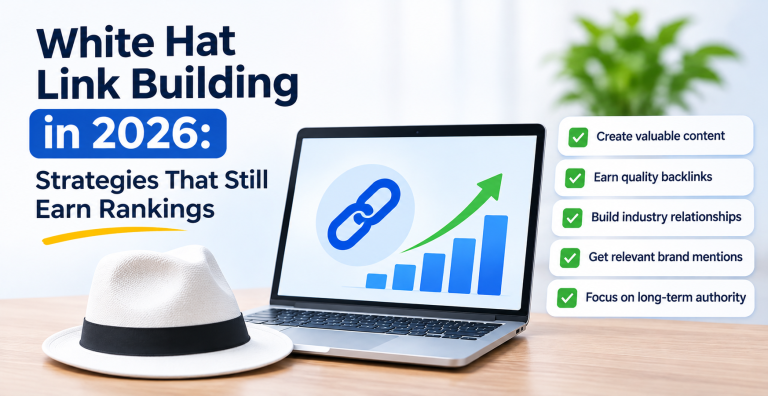
Every year someone claims backlinks no longer matter. Every year Google’s own guidance, and the results on page one, say otherwise. Links are still one of the strongest signals of authority and trust, which is exactly why they are also the easiest way to get your site penalised when you chase them the wrong way. White hat link building is how you earn that authority safely, so your rankings hold up through every algorithm update instead of collapsing after one.
This guide covers what white hat link building actually is, why it still matters in 2026, and eight ethical strategies that continue to earn high-quality links, plus how to do it the right way, what to avoid, and how to measure it.
What Is White Hat Link Building?
White hat link building is the practice of earning backlinks through legitimate, value-first methods that follow Google’s guidelines. Instead of buying links or gaming the system, you create something worth linking to and build genuine relationships, so other websites choose to reference you.
The test is simple: would this link exist if search engines did not? If you earned it because your content, data, or expertise was genuinely useful, it is white hat. If it only exists to manipulate rankings, it is not, and sooner or later it becomes a liability.
White Hat vs Black Hat vs Grey Hat
| White Hat | Grey Hat | Black Hat | |
|---|---|---|---|
| Method | Earned, value-first | Shortcuts in a grey area | Manipulative, against guidelines |
| Examples | Guest posts, digital PR, linkable assets | Bulk outreach, low-quality directories | Buying links, PBNs, link farms |
| Risk | Very low | Medium, can turn risky | High, penalties and lost rankings |
| Longevity | Compounds over time | Unpredictable | Short-lived, then it collapses |
Black hat tactics like buying links in bulk, private blog networks (PBNs), and automated link schemes can produce a quick spike, but Google’s link spam systems increasingly neutralise or penalise them, and the recovery can take months. White hat is slower to start and far more durable, which is why it is the only approach we use for clients.
Why White Hat Link Building Still Matters in 2026
A few shifts have made quality links more important, not less.
- Google keeps tightening link spam detection. Its systems are better than ever at ignoring or penalising manipulative links, so low-quality tactics deliver less and risk more.
- E-E-A-T rewards real authority. Experience, expertise, authoritativeness, and trust are central to how Google evaluates sites, and links from reputable, relevant sources are a core trust signal.
- AI search leans on authority too. As we cover in our guide to AI SEO services, AI engines cite brands the wider web vouches for, so the same mentions and links that help rankings also help you get cited in AI answers.
In other words, the links that are hardest to fake are the ones that now matter most.
8 White Hat Link Building Strategies That Still Work
Here are the strategies that continue to earn durable links in 2026. You do not need all eight; pick the three or four that fit your resources and niche, and do them consistently.
1. Guest posting and editorial contributions
Writing genuinely useful articles for reputable, relevant sites remains one of the most reliable ways to earn contextual, white hat links. The key is relevance and quality: pitch real value to sites your audience actually reads, not low-quality networks that publish anything. Lead your pitch with a topic the site’s readers would genuinely benefit from, keep the link natural and in-context, and treat the article as a chance to demonstrate expertise rather than just drop a link. Done properly, guest posting builds links, referral traffic, and authority at the same time, and the relationships it creates often lead to more opportunities down the line.
2. Digital PR and newsworthy content
Create something journalists and bloggers want to cover, an original study, a strong opinion, a useful tool, or a timely reaction, and pitch it to relevant publications. Digital PR earns links from high-authority news and industry sites that are almost impossible to get any other way, and those links carry serious weight. The trick is to make the story genuinely interesting on its own, with a clear angle and a quotable stat, so a journalist can write about it without feeling like they are doing you a favour.
3. Original research, data, and linkable assets
People link to sources. Publish original research, surveys, statistics, benchmarks, or a genuinely useful free tool, and you give others a reason to cite you. These “linkable assets” keep earning links passively for years, long after the initial promotion. A single well-promoted industry study can collect dozens of referring domains as other writers reach for a number to back up their own articles, which is exactly the kind of compounding, hard-to-fake authority Google and AI engines reward.
4. Broken link building
Find broken links on relevant, authoritative pages, create (or point to) a better replacement, and let the site owner know. You are helping them fix a dead link while earning a relevant one for yourself, which makes it one of the highest-acceptance outreach tactics. Our broken link building approach turns other people’s dead links into your authority.
5. Resource page link building
Many sites maintain “best resources” or “useful links” pages in their niche. If you have a genuinely helpful guide, tool, or asset, a short, relevant pitch to be included is a clean, white hat way to earn a contextual link from a page built specifically to link out.
6. Expert quotes and journalist requests (HARO-style)
Journalists and content creators constantly need expert input. Responding to source requests with a sharp, quotable answer can earn you a credited link from a high-authority publication, plus the credibility of being cited as an expert. It takes consistency, and most of your pitches will not land, but the ones that do are strong, genuinely earned links from sites you could never reach with cold outreach. Reply fast, keep answers concise and specific, and only pitch where you truly have expertise.
7. Turn unlinked brand mentions into links
If other sites already mention your brand, product, or research without linking, that is low-hanging fruit. A friendly note asking them to add a link where it helps their readers often works, because the relationship and the mention already exist. Monitor the web for your brand name and act on these regularly.
8. Strategic internal linking
Internal links are the one “link building” lever you fully control. Linking your pages together logically passes authority to your most important content, helps search engines understand your site structure, and keeps readers engaged. It will not replace external links, but it multiplies the value of every one you earn.
A quick reality check before the next section: white hat link building takes effort, and that is the point. Because these links are hard to earn, they are hard for competitors to copy and hard for algorithms to discount. The time you invest is what makes the result defensible.
How to Earn Links the Right Way
The tactics matter less than the mindset behind them. A few principles keep your link building firmly white hat:
- Lead with value. Earn the link by being useful first, whether that is a better resource, original data, or genuine expertise.
- Prioritise relevance and quality over volume. A handful of links from trusted, relevant sites beats hundreds from random ones, and is far safer.
- Personalise your outreach. Generic, mass-blasted emails get ignored and damage your reputation; relevant, human outreach gets replies.
- Diversify naturally. A healthy link profile has varied sources and anchor text, because that is what genuine authority looks like.
- Be patient. White hat links compound. The profile you build this way keeps working through updates instead of needing constant damage control.
Link Building Tactics to Avoid
Steer clear of anything that only exists to manipulate rankings, including buying links, private blog networks, link farms and exchanges, automated link tools, spammy directory submissions, and over-optimised exact-match anchor text at scale. These can trigger Google’s link spam systems and cost you the rankings you were trying to buy. If a tactic feels like a shortcut around earning the link, treat that as a warning.
How to Measure Link Building Success
Track more than raw link counts. The metrics that reflect real progress are referring domains (how many unique sites link to you), the authority and relevance of those sites, anchor text health, and, ultimately, the rankings and organic traffic your target pages gain over time. A profile that grows steadily with relevant, trusted domains is healthy; a sudden spike of low-quality links is a red flag, even if you did not build them. Review your link profile regularly, disavow genuinely toxic links if you inherit them, and double down where quality links are clearly moving rankings. Tie the work back to business outcomes too: the point of a link is not the link itself but the authority, traffic, and conversions it eventually drives.
Build Links That Last
White hat link building is slower than the shortcuts, and that is exactly why it works: the authority you earn ethically holds up through every algorithm update instead of vanishing after one. Lead with value, target relevant and trusted sites, and stay consistent, and your link profile becomes a durable asset rather than a liability.
If you would rather have specialists earn those links for you, optmistic runs fully white hat link building campaigns that build real authority safely. We have delivered results since 2016, across 220+ projects for clients worldwide, and our team is SEMrush-certified. Get in touch for a free review of your link profile and a plan to strengthen it.
Frequently Asked Questions
What is white hat link building?
White hat link building is earning backlinks through legitimate, value-first methods that follow Google’s guidelines, such as guest posting, digital PR, original research, and broken link building. The links exist because your content or expertise is genuinely useful, not because you paid for or manipulated them.
Is white hat link building still effective in 2026?
Yes, and arguably more than ever. As Google tightens its link spam systems and leans harder on E-E-A-T, high-quality links from relevant, trusted sites remain one of the strongest ways to build authority, lift rankings, and even get cited in AI answers.
What is the difference between white hat and black hat link building?
White hat link building earns links ethically and follows Google’s guidelines, so the results are durable. Black hat link building uses manipulative tactics like buying links, PBNs, and link schemes, which can spike rankings briefly but risk penalties and long-term losses.
How long does white hat link building take to work?
It is a long-term strategy. You may see early movement within a few months, but the real value compounds over time as you steadily earn relevant, authoritative links, and that authority is far more stable than anything bought.
How many backlinks do I need to rank?
There is no fixed number; quality and relevance matter far more than quantity. A handful of links from trusted, relevant sites often outperforms hundreds of low-quality ones. Focus on earning the right links to the right pages rather than hitting a target count.