SEO is not dead. But the SEO you learned a few years ago is quietly fading. Ranking on page one of Google used to be the entire game, and if you did that, you won. Today the game is bigger. The job is to be found, quoted, and chosen across Google and a fast growing set of AI tools. If your playbook still looks the way it did in 2020, you are optimizing for an era that is ending.
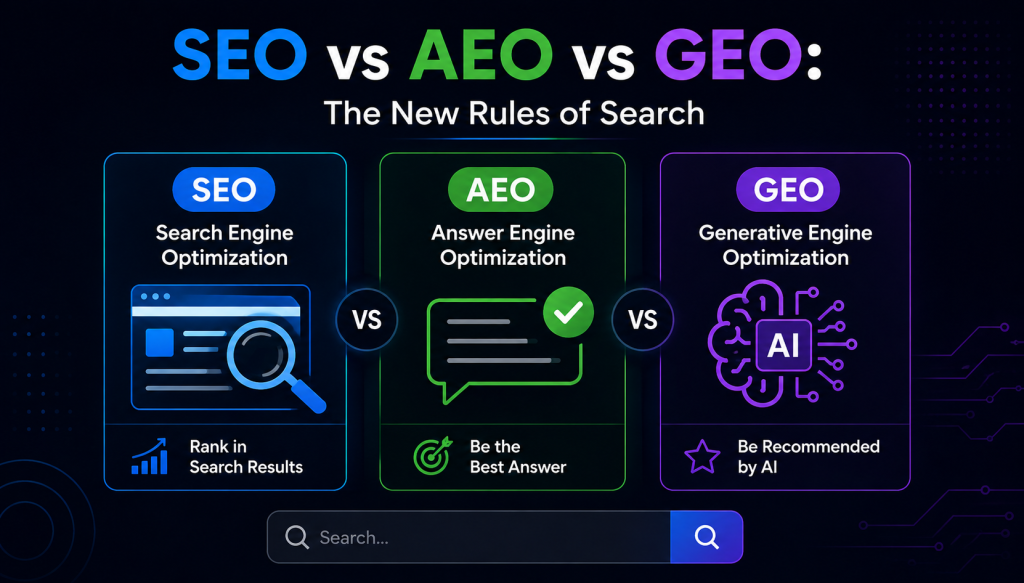
This is the plain English guide to what actually changed. It covers what old SEO was, what shifted under it, what new SEO really means, and how to move with it without throwing away the parts that still work. If you want the deep breakdown of the new acronyms, read our guide to SEO vs AEO vs GEO alongside this one.
What Old SEO Actually Was
Old SEO ran on a simple bargain: rank on Google and you win. Because Google was the only place people searched, a top ranking meant traffic, and traffic meant results. The tactics all pointed at that single goal.
- Keywords were stuffed into every corner of a page.
- Thin, shallow content could still rank if it hit the right terms.
- More volume meant more traffic, so publishing quantity was a strategy on its own.
- Pages were written for crawlers first and people second.
- Almost any backlink counted, so links were chased for the number, not the quality.
- Page one was the finish line. Clicks were victory.
It was not wrong for its time. It worked because search was a closed loop: one engine, one results page, one definition of success.
What Changed
Three forces broke that closed loop, and they arrived faster than the label “SEO” could adapt.
First, Google started answering on the page itself. Featured snippets, People Also Ask, and now AI Overviews often resolve the query before anyone clicks a link. A number one ranking underneath an AI answer is worth far less than a number one ranking used to be.
Second, people began skipping Google entirely. Hundreds of millions now ask ChatGPT, Perplexity, Gemini, and Copilot the questions they once typed into a search bar. These tools do not hand back a list of links. They write an answer and cite a few sources, and being one of those cited sources is a new prize that old tactics do not win.
Third, the quality bar rose. Google’s emphasis on experience, expertise, authority, and trust, along with its growing understanding of entities, rewards genuine credibility over clever tricks. Thin pages and low quality links do little when a system is judging whether you are actually a source worth trusting.
What New SEO Is
New SEO redefines success. It is no longer only about ranking. It is about being retrieved, cited, and trusted wherever your customer is looking, whether that is a Google result, an answer box, or an AI generated recommendation.
That broader goal is served by a wider stack of disciplines: classic SEO to rank, answer engine optimization to be the direct answer, generative engine optimization to be cited inside AI tools, and search experience optimization to turn that visibility into customers. The mindset behind all of it shifts from one question to another: not “how do I rank,” but “how do I become the trusted answer.”
Why Trust and Authority Now Win
If old SEO rewarded signals you could manufacture, new SEO rewards signals you have to earn. Google’s emphasis on experience, expertise, authoritativeness, and trust, often shortened to E-E-A-T, means the search engine is actively trying to judge whether real, credible people stand behind your content. AI engines do something similar when they decide which sources to cite in an answer.
Both reward the same things: genuine expertise, a recognizable brand, references from other trusted sites, and content that shows first hand knowledge rather than rephrasing whatever already ranks. This is why entity and authority building has moved to the center of the work. You are no longer just optimizing a page, you are proving that your brand is a source worth trusting, and that is far harder to fake than a keyword or a link.
Old SEO vs New SEO
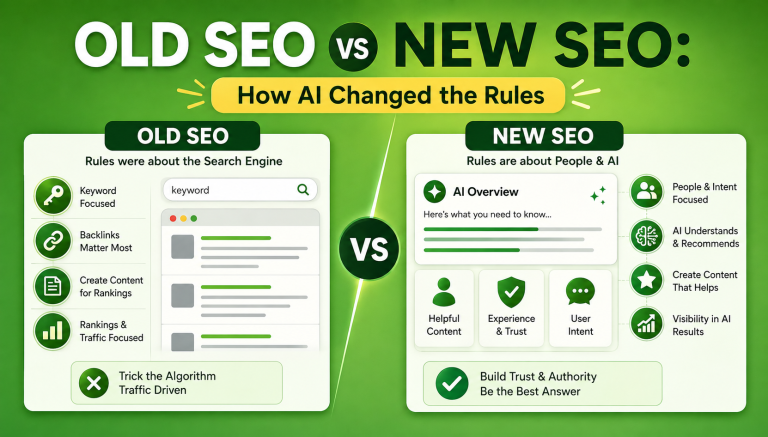
Laid side by side, the change is less about new tricks and more about a new definition of winning.
| Old SEO | New SEO | |
|---|---|---|
| Goal | Rank on page one of Google | Be found, cited, and chosen across Google and AI |
| What counted | Keywords and volume | Authority, entity trust, and clear answers |
| Content | Written for engines | Written for people, structured for machines |
| Links | Any backlink counted | Quality, relevant citations |
| Success metric | Clicks and rankings | Mentions, citations, and conversions |
| Biggest risk | One algorithm update wipes your traffic | Visibility spread safely across many surfaces |
| End goal | Page one ranking | Retrieval, citation, trust, then conversion |
Old SEO vs New SEO in Practice
To make the shift concrete, picture optimizing a single page, then and now. In the old model, you would pick one keyword, work it into the title, headings, and body a set number of times, point some links at the page, and wait to rank. The page existed to hit a term.
In the new model, you start from the question behind the keyword. You answer it clearly and early so it can be pulled into a snippet or an AI answer, cover the related questions a reader would ask next, add credible data and sources so a model trusts it, and connect it to the rest of your site so it earns authority. It is the same page, but a completely different definition of what makes it good. Old SEO asked whether the page was optimized. New SEO asks whether it is the best, most trustworthy answer available.
What Still Works, So Do Not Throw It All Out
New SEO builds on old SEO, it does not delete it. The foundation is almost entirely unchanged, and anyone telling you to abandon it is selling something.
Keyword and intent research still tells you what people want. Genuinely useful content is still what earns rankings and citations alike. Quality links still signal authority, and a fast, crawlable, error free site is still the price of entry. A healthy technical SEO base matters more than ever, because a model cannot cite a page it cannot reliably read. The fundamentals did not change. What changed is what you build on top of them.
What to Stop Doing
The parts of old SEO that are genuinely fading are the shortcuts, the tactics that gamed the system rather than served the reader.
- Stuffing keywords instead of answering the question clearly.
- Publishing thin pages for volume, hoping quantity beats quality.
- Chasing any backlink for the count rather than earning relevant ones.
- Judging success by a single ranking while ignoring answers and citations.
- Writing for crawlers when the reader, and now the AI, both reward clarity.
Signs You Are Still Doing Old SEO
Not sure which era your SEO belongs to? These are the tell tale signs you are still playing the old game.
- You measure success almost entirely by keyword rankings and total traffic.
- You publish content mainly to hit a keyword, not to genuinely answer a question.
- You judge a page by its word count and keyword density rather than its usefulness.
- You still chase links by quantity, without caring much about the quality of the site linking to you.
- You have never checked whether your content appears in AI answers or featured snippets.
If several of these sound familiar, you are optimizing for an era that is fading. The good news is that the fix is not complicated. It is a shift of emphasis, not a rebuild.
The New SEO Stack in One Line
The new landscape is often described with four acronyms, and they are simpler than they look. SEO gets you ranked. AEO gets you selected as the answer. GEO gets you cited by AI tools. SXO makes the experience good enough to convert the visit. Some people wrap all of it under AIO, meaning AI optimization. For the full side by side of what each one means and how to do it, see our SEO vs AEO vs GEO guide.
How to Make the Shift
Moving from old to new SEO is less a rebuild than a widening. You keep doing the fundamentals, and you add a few new habits.
- Audit which of your pages already get pulled into snippets or AI answers, and learn what those pages do well.
- Restructure content so answers are easy to extract: clear question headings, a direct answer in the first few lines, and FAQ or How To schema.
- Invest in genuine authority and entity signals so both Google and AI models understand who you are and trust what you publish. Strong content marketing is how that trust gets built.
- Widen your reporting beyond rankings to include answer share and how often AI tools mention your brand.
- Fix the post click experience, because being found means nothing if the page loses the visitor.
The New End Goal
Old SEO ended at a ranking. Clicks were the scoreboard. New SEO runs one step further, along a chain that looks like this: retrieval, then citation, then trust, then conversion. Your brand does not just rank. It gets found, surfaced in the answer, trusted enough to be named, and then chosen.
That is the real shift. The finish line moved from “did we rank” to “were we the answer people were given, and were we the name they remembered.”
The Bottom Line
Old SEO is not wrong. It is incomplete. The fundamentals of useful content, real authority, and technical health still power everything, but the definition of winning has grown beyond a single ranking. Optimize for the whole journey, ranking, answering, and being cited, and measure success by influence rather than clicks alone.
If you want a clear read on where your site stands in this new landscape and what to fix first, our team can audit it and map the plan. Get in touch for a free consultation.
Frequently Asked Questions
Is SEO dead?
No. SEO is evolving, not dying. Its goal has widened from ranking on Google to being found, cited, and trusted across search and AI tools. The fundamentals of useful content, authority, and technical health still matter, and now power AI visibility too.
What is the difference between old SEO and new SEO?
Old SEO aimed to rank on page one and treated clicks as success. New SEO aims to be found, quoted, and chosen across Google and AI engines, and measures success by mentions, citations, and conversions, not rankings alone.
Do old SEO tactics still work?
The fundamentals do: keyword and intent research, genuinely useful content, quality links, and a fast, crawlable site. The shortcuts do not, such as keyword stuffing, thin content for volume, and chasing any backlink for the count.
Is keyword research still relevant?
Yes, but it has shifted from chasing exact match volume to understanding intent and the real questions people ask. Those questions now feed not only rankings but answer boxes and AI responses, so the research matters across every surface.
What is the new goal of SEO?
The new goal follows a chain: be retrieved, get cited, earn trust, and drive conversions. Instead of stopping at a ranking, the aim is to be the answer people are given and the brand they remember and choose.
Do I need to relearn SEO from scratch?
No. New SEO builds on the old foundation rather than replacing it. You keep the fundamentals and add a few habits, such as structuring content for extraction, building entity authority, and tracking AI mentions alongside rankings.
What is the biggest change AI brought to SEO?
The biggest change is that ranking no longer equals being seen. Google answers many queries on the page, and AI tools answer them off Google entirely, so the job expanded from ranking a link to being the cited source inside the answer.
How do I measure new SEO success?
Keep tracking rankings and organic traffic, then add answer and snippet share and AI share of voice, meaning how often and how favorably AI tools mention your brand. Success is measured by influence across surfaces, not clicks alone.
Should small and local businesses worry about new SEO?
Yes, and it is an opportunity. Local and service businesses often win quickly by being the direct answer to high intent questions on mobile, voice, and AI tools, without needing the domain power that ranking against big brands requires.
Is new SEO harder than old SEO?
In one way yes, because you cannot game it with shortcuts anymore. In another way it is simpler: focus on being genuinely useful and credible, and you satisfy both old and new SEO at the same time. The difficulty moved from tricks and tactics to substance and trust.
What is E-E-A-T and why does it matter now?
E-E-A-T stands for experience, expertise, authoritativeness, and trust. It is how Google assesses whether credible people and brands stand behind your content. It matters more now because both search engines and AI tools favor trustworthy sources, so building genuine authority is central to new SEO.
What is the first step to modernize my SEO?
Audit your existing content by search intent and check whether any of it appears in featured snippets or AI answers. Then strengthen your weakest area, usually the clarity, structure, and credibility of pages you already have, before creating anything new. Small shifts to existing content often move the needle fastest.