Few things are more alarming for a website owner than watching traffic and rankings suddenly collapse. Often, the cause is a Google penalty. A penalty means Google has decided your site violated its guidelines, and as a result your visibility drops sharply. The good news is that most penalties can be diagnosed and recovered from with the right approach. This guide explains what Google penalties are, how to identify them, and the step by step process to recover.
Getting your rankings back takes patience and care, but it is absolutely possible. If you want expert help diagnosing and fixing the problem quickly, professional Google penalty recovery services can guide you through the entire process.
What Is a Google Penalty?
A Google penalty is a negative action against your website that lowers its rankings or removes it from search results. It happens when Google believes your site has broken its guidelines, whether intentionally or by mistake. Penalties can affect your whole site or just specific pages, and they can cause a dramatic loss of traffic. Understanding the type of penalty you are facing is the first step to recovering from it.
The Two Types of Google Penalties
Manual Penalties
A manual penalty is applied by a human reviewer at Google when they find a violation on your site. When this happens, you receive a notification in Google Search Console explaining the issue. Common causes include unnatural links, thin or spammy content, and deceptive practices. Because you are told exactly what is wrong, manual penalties are often clearer to diagnose and fix.
Algorithmic Penalties
An algorithmic penalty is not a manual action but a drop in rankings caused by a Google algorithm update. There is no notification, so you have to connect the timing of your traffic drop with known updates to identify it. These require you to bring your site in line with the quality standards the algorithm rewards, after which your rankings can recover over time.
How to Identify a Google Penalty
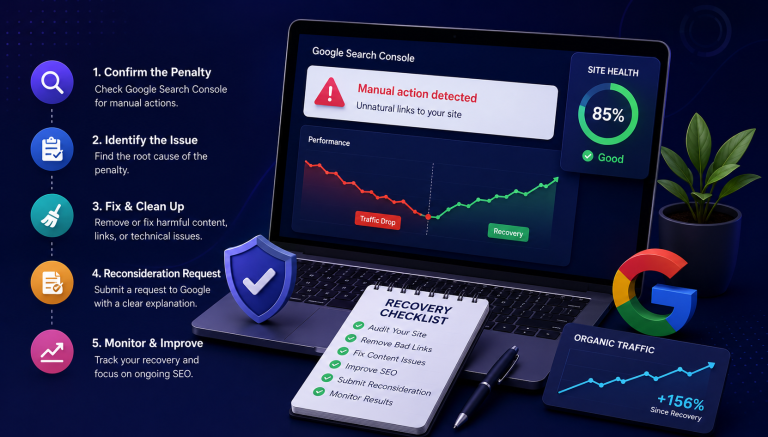
Before you can recover, you need to confirm what happened. Start by checking Google Search Console for any manual action notifications, which tell you directly if you have been penalized. If there is no manual action, look at your analytics to pinpoint exactly when your traffic dropped, then compare that date with known algorithm updates. Also review whether the drop affects your whole site or specific pages. This investigation reveals whether you are dealing with a manual or algorithmic issue and points you toward the cause.
Signs You May Have Been Penalized
Not every traffic drop is a penalty, so it helps to recognize the warning signs. A sudden, steep loss of organic traffic, a sharp fall in rankings for keywords you used to rank for, specific pages disappearing from search, or a message in Search Console are all strong indicators. If your traffic declined gradually over time, the cause may be increased competition or outdated content rather than a penalty. Distinguishing between these situations ensures you spend your effort fixing the right problem.
How to Recover From a Google Penalty
1) Diagnose the Exact Problem
Recovery starts with an honest audit. Identify whether the issue is unnatural backlinks, low quality content, keyword stuffing, technical problems, or something else. Use Search Console, analytics, and a thorough site review to pinpoint the root cause. You cannot fix a penalty until you understand exactly what triggered it.
2) Clean Up Unnatural Links
If the penalty is link related, review your backlink profile and identify spammy, paid, or irrelevant links pointing to your site. Where possible, reach out to have harmful links removed. For links you cannot remove, you can ask Google to ignore them so they no longer count against you. A clean, natural link profile is essential for recovery.
3) Fix or Remove Low Quality Content
If thin, duplicate, or spammy content is the problem, address it directly. Improve weak pages with original, valuable content, consolidate or remove duplicates, and make sure everything genuinely helps your visitors. High quality content that satisfies search intent is exactly what Google wants to see.
4) Resolve Technical and Guideline Issues
Some penalties stem from deceptive or technical problems, such as hidden text, cloaking, sneaky redirects, or intrusive practices. Remove anything that could be seen as manipulative or misleading, and make sure your site fully complies with Google’s guidelines. Bringing your site into line removes the reason for the penalty.
5) Submit a Reconsideration Request
If you received a manual penalty, once you have fixed the issues you can submit a reconsideration request through Search Console. Explain clearly what was wrong and the specific steps you took to fix it. Be honest and thorough, since a well documented request improves your chances of having the penalty lifted.
6) Wait and Monitor Your Recovery
Recovery is not always instant. For manual penalties, Google reviews your request and responds, while algorithmic recovery happens gradually as Google recrawls and reassesses your site. Monitor your rankings and traffic closely, stay patient, and keep improving your site while you wait for your visibility to return.
7) Rebuild Trust and Authority
Once the penalty is resolved, focus on rebuilding your site’s reputation. Publish strong, original content, earn quality links naturally, and improve the overall experience for your visitors. This not only helps your rankings recover more fully but also makes your site more resilient against future issues. Recovery is a chance to build a healthier, stronger website than before.
Manual vs Algorithmic Penalties: Key Differences
Knowing which type of penalty you face changes how you respond. The main differences are:
- Notification: manual penalties come with a Search Console alert, while algorithmic ones do not.
- Cause: manual penalties follow a human review, while algorithmic drops follow an update.
- Recovery: manual penalties require a reconsideration request, while algorithmic recovery happens as Google recrawls your improved site.
- Timing: manual penalties can lift relatively quickly once fixed, while algorithmic recovery is usually more gradual.
Identifying the type correctly saves you time and points you toward the right recovery path.
How to Avoid Future Google Penalties
The best cure is prevention. Follow Google’s guidelines, focus on creating genuinely helpful content, and earn links naturally rather than buying them. Keep your site technically healthy, avoid shortcuts and manipulative tactics, and monitor your performance regularly so you can catch problems early. A commitment to quality and ethical search engine optimization is the most reliable way to stay penalty free.
Common Causes of Google Penalties
- Unnatural or paid backlinks meant to manipulate rankings.
- Thin, duplicate, or low quality content.
- Keyword stuffing and over optimization.
- Hidden text, cloaking, or sneaky redirects.
- A poor user experience or intrusive elements.
Frequently Asked Questions
How do I know if my site has a Google penalty?
Check Google Search Console for manual action notices, and compare any sudden traffic drops with known algorithm updates. A sharp, unexplained loss of rankings is often a sign of a penalty.
How long does it take to recover from a Google penalty?
It varies. Manual penalties can be lifted within days or weeks of a successful reconsideration request, while algorithmic recovery may take longer as Google reassesses your site.
Can I recover from a penalty on my own?
Yes, especially for straightforward issues. However, complex cases involving large backlink profiles or serious violations often benefit from professional help to recover faster and avoid mistakes.
Will my rankings return to where they were?
Often they can, but there is no guarantee. Once the underlying issues are fixed and your site meets Google’s standards, your rankings can recover, sometimes stronger than before if your overall quality improves.
What is a reconsideration request?
A reconsideration request is a message you send to Google through Search Console after fixing a manual penalty. In it, you explain the issues you found and the specific steps you took to resolve them, asking Google to review your site and lift the penalty.
Can bad backlinks hurt my site even if I did not create them?
Yes. Sometimes competitors or spammy sites create harmful links to your site. If these become a problem, you can review your backlink profile and ask Google to ignore the toxic links so they no longer count against you.
Conclusion
A Google penalty can be stressful, but it is not the end of your website. By identifying whether the penalty is manual or algorithmic, diagnosing the exact cause, and carefully fixing the issues, you can recover your rankings and traffic. Above all, commit to quality and follow Google’s guidelines so you stay penalty free in the future. Treat a penalty as a wake up call rather than a disaster. Many sites emerge from recovery healthier and more resilient than they were before, because the process forces them to fix long standing weaknesses and build on a foundation of genuine quality.
If your site has been hit by a penalty and you want to recover quickly, Optmistic Technologies offers dedicated Google penalty recovery services to diagnose, fix, and restore your rankings. Request a free quote and get your traffic back on track.