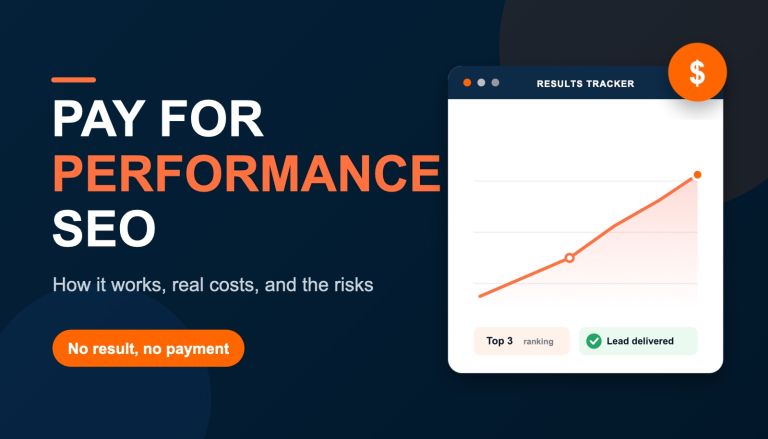
Pay for performance SEO sounds almost too good to be true. Instead of paying an agency every month whether your rankings move or not, you only pay when the work actually delivers a result, such as a first-page ranking, a lift in organic traffic, or a qualified lead. For a business that has been burned by a retainer with little to show for it, that promise is very attractive.
It is also the reason so many people search to find out whether this model is legit or a quiet trap. The honest answer sits in the middle. Pay for performance SEO can be a smart, low-risk way to buy search results, and it can also be a setup that costs you more, damages your website, or pushes an agency toward shortcuts. This guide breaks down exactly how the model works, what the three pricing structures really cost, where the risks hide, and how to tell a trustworthy provider from a risky one.
What Is Pay for Performance SEO?
Pay for performance SEO is a pricing model where your payment is tied to measurable outcomes rather than to hours worked or a flat monthly fee. You and the provider agree on a specific result in advance, and you are billed only when that result is achieved and, in most contracts, only for as long as it holds.
You will also see the same idea called pay on results SEO, pay per result SEO, pay for results SEO, results-based SEO, or simply performance-based SEO. Some providers use pay per performance SEO, pay per results SEO, or pay on performance SEO, and a few flip the words and label it SEO pay for performance. The names differ, but the core promise is identical: no result, no payment.
This is very different from traditional search engine optimization, where you pay a fixed monthly amount for an agreed scope of work and carry the risk if results are slow to arrive. With the performance model, the provider carries more of that risk, which is exactly why the details of how a result is defined and measured matter so much.
How Pay for Performance SEO Actually Works
Most searchers are told they simply pay for results, but very few pages explain how those results are defined and tracked. That measurement layer is where good arrangements are won or lost, so it is worth understanding the full sequence before you sign anything.
A typical pay for performance engagement runs through five stages:
- Baseline and keyword selection. The provider records where your target keywords currently rank, so both sides know the starting point. You agree on the exact keywords or the type of lead that will count.
- Defining the trigger. You set the outcome that unlocks payment. Common triggers are a keyword reaching the top 10, the top 5, or the top 3, a set increase in organic traffic, or a qualified lead or phone call from organic search.
- Choosing the source of truth. You agree on which rank tracker, analytics property, or call-tracking tool will be used, and how often it is checked. This single detail prevents most future disputes.
- The work. The provider carries out on-site and off-site SEO, including technical fixes, content, and links, to move the agreed metric.
- Billing on the result. Once a keyword holds its position or a lead comes in, you are billed for that outcome. Many contracts prorate the fee if a ranking slips in and out during the month, and some add a monthly cap.
A short example makes the billing clearer. Suppose you agree to pay $100 per keyword for any of ten target terms that reach the top three positions. If six of them get there and hold for the month, you are billed $600 for that month and nothing for the four that did not. If one of those six slips to position five for half the month, a fair contract prorates that keyword rather than charging the full fee. That level of detail is exactly what you want written down.
The cleanest agreements spell out what counts as a result in plain language. They name the rank tracker, define a qualified lead, describe how a keyword that bounces around position 8 to 12 is handled, and confirm whether you owe anything if the target is never reached. If a provider is vague about any of these, treat that as a warning sign rather than a detail to sort out later.
Pay for Performance SEO Pricing: The 3 Models With Real Numbers
Pay for performance SEO pricing usually follows one of three models, and most pay for performance SEO services are built around one of these structures. Real figures are rarely published, so the ranges below are drawn from what providers actually quote. Treat them as a guide, because the true price depends on your industry, keyword difficulty, and how competitive your market is. One important shift to know in 2026 is that pure pay for rankings deals are fading out, because rankings alone are easy to game with low value keywords that never drive real business. The model most reputable providers now use is a hybrid one, a reduced base retainer of around 60 to 70 percent of a standard fee plus milestone bonuses tied to meaningful results such as organic revenue or qualified leads. Where per keyword pricing is still offered, reaching a top three position for a competitive term commonly runs from about $500 to $3,000 per keyword.
| Model | How you pay | Typical range | Best for | Watch out for |
|---|---|---|---|---|
| Pay per ranking | A set fee for each target keyword once it holds an agreed position | About $50 to $150 per keyword each month, plus a $250 to $500 setup fee. Top three positions can cost more. | Businesses with a clear list of commercial keywords | Ranking for easy, low-intent keywords that do not drive sales |
| Pay per lead | A fixed price for each qualified lead or call from organic search | About $20 to $150 per lead, and higher in legal, medical, and finance niches | Local and service businesses that can define a qualified lead | Disputes over which leads count and over lead quality |
| Revenue share | A percentage of the sales attributed to organic search | Roughly 5 to 20 percent of attributed revenue | Ecommerce and businesses with solid analytics | How accurately organic revenue is attributed |
Notice that no model is free of setup costs. Most providers charge an onboarding or audit fee up front to cover the technical work needed before any ranking can move, so a claim of zero cost until you rank is usually only part of the story.
Pay for Performance SEO vs. Traditional Monthly SEO
The performance model is best understood next to the retainer it is meant to replace. Each one shifts risk and reward in a different direction, and the right choice depends on how much certainty you want and how clearly you can define success.
| Factor | Pay for performance SEO | Traditional monthly retainer |
|---|---|---|
| Upfront risk | Low, you mostly pay after results | Higher, you pay whether or not results come |
| Cost predictability | Variable, tied to outcomes | Fixed and easy to budget |
| Total cost over time | Often higher once results land | Often lower for the same work |
| Scope of work | Narrow, focused on trigger keywords | Broad, full strategy and brand growth |
| Risk of shortcuts | Higher, pressure to hit targets fast | Lower in most cases |
| Best when | You want accountability and clear KPIs | You want long-term organic and brand growth |
The pattern is consistent. You trade a higher total cost for lower upfront risk, and you trade a broad strategy for a narrow focus on the keywords that trigger payment.
Pros of Pay for Performance SEO
The model has genuine strengths, and they are the reason it keeps attracting interest despite the criticism it receives.
- Low upfront risk. You are not paying large fees for months before anything happens, which protects your cash flow.
- Aligned incentives. The provider only earns when you win, so both sides are pointed at the same goal.
- Built-in accountability. Results are defined and tracked from day one, so there is no hiding behind vague activity reports.
- Easy to justify. Paying for a ranking or a lead is simple to explain to a manager or a client who wants to see a clear return.
Cons, Risks, and Red Flags
This is the section that most sales pages leave out, and it is the part you cannot afford to skip. The same structure that aligns incentives can also create pressure that works against you.
- Pressure toward shortcuts. When payment depends on fast rankings, some providers turn to black-hat tactics such as spammy links or cloaking that can trigger a Google penalty and undo months of progress.
- Vanity keywords. A provider may chase easy, low-competition keywords that rank quickly but bring little traffic or revenue, so you pay for positions that do not move your business.
- Short-term thinking. The model rewards quick wins, not the durable foundation that a strong technical SEO base and quality content provide.
- Narrow scope. Because only trigger keywords are paid for, wider work such as content strategy and brand building is often ignored.
- Measurement disputes. Vague definitions of a result lead to arguments over which rankings or leads actually count.
- Hidden costs. Setup fees, minimum terms, and per-keyword pricing can add up to more than a straightforward retainer over a full year.
Is Pay for Performance SEO Legit? When It Is Smart vs. When It Is a Trap
Pay for performance SEO is a legitimate model, not a scam by definition. Serious agencies offer it and honor it. That said, the structure attracts a share of low-quality providers, so the real question is not whether the model is legit but whether it fits your situation and whether the specific provider is trustworthy.
It tends to be a smart choice when:
- You can define success as a clear, measurable outcome such as a ranking or a lead.
- Your keywords have real commercial intent, so a ranking actually means revenue.
- The provider commits in writing to white-hat methods and transparent reporting.
- You want to limit upfront risk while you test a new SEO partner.
It tends to become a trap when:
- The provider will not name the exact keywords, tracker, or definition of a lead.
- You are pushed to accept easy keywords that sound impressive but do not convert.
- There is no visibility into the tactics being used on your site.
- The contract locks you into a long minimum term with steep exit penalties.
Is Pay for Performance SEO Right for Your Business?
The model fits some businesses far better than others. Use this quick checklist to see where you land before you start comparing providers.
It is usually a good fit if you run a local or service business, an ecommerce store, or a lead-driven company with a short sales cycle and a clear set of money keywords. In those cases a ranking or a lead maps directly to revenue, which is exactly what the model is built to reward.
It is usually a poor fit if you have a long or complex sales cycle, if you are building a brand where the payoff is spread across many soft touch points, or if your growth depends on content marketing and authority that cannot be reduced to a single ranking. In those cases a broad retainer strategy will almost always serve you better.
How to Vet a Pay for Performance SEO Company
Once you decide the model suits you, the provider you choose matters more than the pricing structure itself. The following questions and checks separate a reliable partner from a risky one.
Ask every provider these questions before you sign:
- Which exact keywords will you target, and how did you choose them?
- What position, traffic level, or lead definition triggers payment, and which tool measures it?
- How do you handle a keyword that moves in and out of the target position?
- What happens to my rankings and my content if I end the contract?
- Can you show on-page optimization and link work from past clients, with references?
Then watch for these red flags. Treat any single one as a reason to slow down and dig deeper.
- Guarantees of a number one ranking on a fixed date, which no honest provider can promise.
- Refusal to disclose the tactics or the links being built for you.
- Prices quoted per keyword with no link to whether that keyword drives sales.
- Contracts that hide setup fees or bury a long lock-in period in the fine print.
How Optmistic Approaches Performance-Based SEO
At Optmistic Technologies we believe the appeal of the performance model, accountability and a clear link between spend and results, should be part of every SEO engagement, not a separate product with hidden trade-offs. So we lead with transparency: agreed KPIs, a named tracking tool, honest reporting, and strictly white-hat methods that protect your site rather than gamble with it.
If you like the idea of paying for outcomes but want to avoid the shortcuts and vanity metrics that sink cheap performance deals, talk to us about a results-focused SEO plan built around the keywords that actually grow your revenue. You can get in touch for a free consultation and we will show you exactly how we measure and report on the results you are paying for.
Conclusion
Pay for performance SEO is neither a miracle nor a scam. It is a pricing model that shifts risk in exchange for a narrower focus and, often, a higher total cost. It rewards businesses that can define success clearly and punishes those that cannot. Understand how the trigger is measured, read the pricing in full, insist on white-hat work, and vet the provider as carefully as the model, and you can use it to buy real search results with confidence rather than crossed fingers.
FAQs
1. What is pay for performance SEO?
Pay for performance SEO is a pricing model where you pay only when the provider delivers an agreed outcome, such as a keyword reaching a target position, a rise in organic traffic, or a qualified lead. It is also called pay on results SEO or results-based SEO.
2. How does pay for performance SEO work?
You and the provider agree on a baseline, the exact keywords or leads that count, and the tool that will measure them. The provider then does the SEO work, and you are billed only once a keyword holds its agreed position or a lead is delivered.
3. Is pay for performance SEO legit or a scam?
The model itself is legitimate and many reputable agencies offer it. However, its structure attracts some low-quality providers, so the risk lies in the specific company rather than the model. Clear definitions, white-hat methods, and transparent reporting are the signs of a legit provider.
4. How much does pay for performance SEO cost?
Pricing varies by model. Pay per ranking often runs about $50 to $150 per keyword each month plus a setup fee, pay per lead is roughly $20 to $150 per lead, and revenue share is usually 5 to 20 percent of attributed sales. Industry and keyword difficulty push these figures up or down.
5. How is payment measured in pay for performance SEO?
Payment is measured against a trigger you agree on in advance, tracked by a named rank tracker, analytics property, or call-tracking tool. The best contracts also explain how a keyword that moves in and out of position is handled and whether the fee is prorated.
6. Is pay for performance SEO cheaper than a monthly retainer?
It lowers your upfront risk because you pay after results, but over a full year the total cost is often higher than a comparable retainer once setup fees and per-keyword charges are added up. It trades predictability for accountability rather than for a lower price.
7. What is the difference between pay for performance SEO and traditional SEO?
Traditional SEO is a fixed monthly fee for an agreed scope of work, and you carry the risk if results are slow. Pay for performance SEO ties your payment to specific outcomes, so the provider carries more of that risk but usually focuses on a narrower set of keywords.
8. How long does pay for performance SEO take to show results?
SEO of any kind typically takes three to six months to move competitive keywords, and the performance model is no different. Be cautious of any provider that promises top rankings within days or weeks, since that speed usually points to risky tactics.
9. What happens if the agency does not hit the agreed goals?
In a true pay for performance arrangement you owe nothing for a result that is never achieved. Read the contract closely, though, because many providers still charge a setup or audit fee up front regardless of the outcome.
10. Are there hidden fees or setup costs in pay for performance SEO?
Often yes. Most providers charge an onboarding, audit, or setup fee to cover the technical work needed before rankings can move, so a claim of zero cost until you rank rarely tells the whole story. Ask for a full list of fees before you sign.
11. Is pay for performance SEO good for small or local businesses?
It can be a strong fit for local and service businesses because a ranking or a phone call maps directly to revenue and the upfront risk is low. The key is choosing keywords with genuine commercial intent rather than easy terms that never convert.
12. What are the biggest risks of pay for performance SEO?
The main risks are providers using black-hat tactics that lead to a Google penalty, chasing vanity keywords that do not drive sales, and vague contracts that spark disputes over which results count. Transparent reporting and white-hat methods reduce all three.
13. How do I choose a reputable pay for performance SEO company?
Ask which keywords and metrics trigger payment, which tool measures them, and what happens if you leave. Insist on white-hat methods and references, and walk away from any company that guarantees a number one ranking on a fixed date or refuses to explain its tactics.