Enterprise SEO is not simply regular SEO at a larger scale. It is a different category of work, with different priorities, different tools, different team structures, and different failure modes. A standard SEO engagement for a local business or a startup might involve 20 to 50 pages, a single decision-maker, and a three-month timeline to measurable results. An enterprise SEO programme manages hundreds or thousands of pages, multiple internal stakeholders across marketing, engineering, legal, and content, and a timeframe where a single technical change rolled out incorrectly can drop organic traffic by 30% in 48 hours.
This guide explains what enterprise SEO actually involves, how it differs from standard SEO in practical terms, what the core disciplines are, which tools the field relies on, and how to evaluate whether an enterprise-level SEO approach is what your business needs. We draw on experience running SEO audits and strategies across large sites in the US, UK, Canada, and Australia, including multi-location service businesses, national e-commerce stores, and B2B platforms with complex site architectures.
What Is Enterprise SEO?
Enterprise SEO is the practice of managing and improving organic search performance across large, complex websites. The defining characteristics are scale (hundreds to millions of pages), organizational complexity (multiple teams who each have a stake in how the site is built and maintained), and competitive stakes (the site is typically competing in high-value keyword categories where small ranking changes translate directly to significant revenue impact).
The threshold for ‘enterprise’ is not a specific page count or revenue figure. A 500-page e-commerce site competing in a category with strong national competitors needs enterprise-level thinking, even if the business itself is mid-market. A 10,000-page corporate site that operates in an uncompetitive niche may function well with standard SEO processes. What matters is the complexity of the ranking challenges and the organizational structure around the website, not just its size.
How Enterprise SEO Differs from Standard SEO
The differences between enterprise and standard SEO are practical, not just theoretical. Understanding them helps both businesses evaluating their SEO approach and SEO professionals scoping what an engagement actually involves.
Scale and Site Architecture
Standard SEO typically works at the page level: optimize this title tag, rewrite this page’s content, build links to this URL. Enterprise SEO works at the template level. When a site has 10,000 product pages built from the same template, you do not optimize each page individually. You identify the pattern of SEO problems in the template, fix the template, and the change propagates across all 10,000 pages. This requires understanding how the site is built at a technical level, not just how it looks in a browser. It also requires coordination with development teams who own the templates, which introduces deployment timelines, testing cycles, and change management processes that do not exist in standard SEO work.
Crawl Budget and Indexation Management
On a 50-page website, crawl budget is irrelevant. Googlebot will crawl every page without any special configuration. On a site with 50,000 pages, crawl budget management is one of the highest-priority technical tasks. Enterprise SEO involves systematically auditing which pages are being crawled, which are being indexed, which are wasting crawl budget (duplicate pages, parameterised URLs, thin paginated content), and configuring robots.txt, canonical tags, and noindex directives to ensure Googlebot’s crawling capacity is focused on pages that matter. Mismanaged crawl budget on large sites is a common cause of important pages being under-indexed or ranking poorly despite strong content.
Content at Scale and Programmatic SEO
Large sites often need content across hundreds of location pages, product category pages, or topic cluster pages that cannot be written individually. Enterprise SEO involves building content templates and editorial guidelines that allow quality content to be produced at volume without sacrificing the specificity and depth that earns rankings. This is distinct from programmatic SEO, which involves auto-generating pages from data. Programmatic SEO can work well for certain site types (job boards, property listings, travel comparison sites) but carries significant risk if the output is thin or duplicative. Enterprise SEO strategy defines where programmatic approaches are appropriate and where human-authored content is necessary for ranking.
Cross-Team Coordination
In a small business, the person who decides the SEO strategy is typically the same person who implements the changes. In an enterprise context, the SEO team identifies the required changes, but implementation requires sign-off from product, engineering, legal, or brand teams who each have their own priorities. A title tag change might need legal review for compliance reasons. A site architecture change might require a 6-week engineering sprint. A content update to a product page might require brand approval. Enterprise SEO professionals spend a significant portion of their time managing these internal processes and building the cross-functional relationships required to get SEO work actually shipped. This is invisible in most enterprise SEO discussions but is one of the primary determinants of whether an enterprise SEO programme produces results.
Link Building and Authority at Scale
The link building strategy for an enterprise site differs from standard link building in both approach and volume. Enterprise sites typically have existing domain authority that smaller sites do not, which shifts the focus from raw link acquisition to strategic distribution of that authority across the site through internal linking, and to protecting the link profile from negative SEO and algorithmic penalties. Outbound link acquisition at enterprise level often involves digital PR campaigns, data-driven content that earns editorial links at scale, and partnership-based link programmes rather than individual outreach.
Core Enterprise SEO Disciplines
Enterprise SEO is best understood as five overlapping disciplines rather than a single practice. Most enterprise SEO programmes involve all five to varying degrees depending on the site’s current state and competitive position.
- Technical SEO infrastructure: crawl management, indexation, site speed and Core Web Vitals at scale, structured data deployment, JavaScript rendering issues, log file analysis, and international hreflang configuration for multilingual sites.
- Content architecture and on-page optimization: URL structure, information architecture, keyword mapping across thousands of pages, content quality auditing at scale, and editorial guidelines that maintain consistency across large content teams.
- Authority building: domain-level and page-level link acquisition, digital PR, internal link equity distribution, and disavow management for sites that have accumulated toxic backlinks over years of operation.
- Analytics and measurement: enterprise analytics setups are typically more complex than standard GA4 implementations. They involve custom event tracking, attribution modelling across multiple touchpoints, integration with CRM data, and reporting frameworks that translate SEO metrics into business revenue impact.
- Governance and process: the internal processes that ensure SEO requirements are built into product roadmaps, content production pipelines, and site change management. Without SEO governance, large sites frequently have their organic performance degraded by internal changes made without SEO review.
Enterprise SEO Tools
The toolset for enterprise SEO differs from standard SEO tool usage primarily in volume capacity and team collaboration features. Standard SEO tools like Ahrefs and Semrush work well for individual practitioners managing a small number of accounts. Enterprise programmes typically require tools with higher crawl limits, API access for custom reporting, and user management for teams.
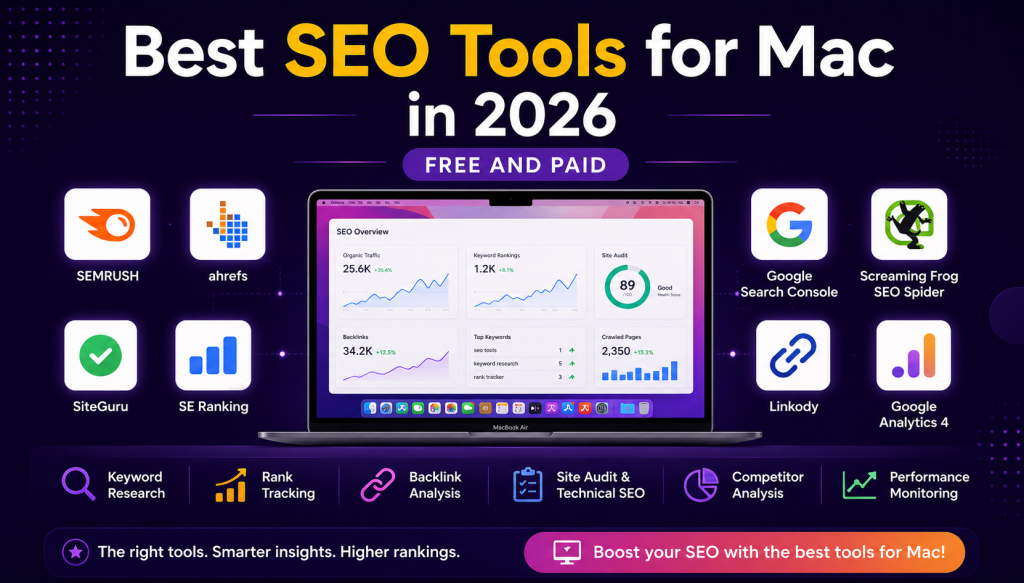
- Screaming Frog SEO Spider: the most used tool for technical site crawls. The paid version handles unlimited URLs and is standard across enterprise technical SEO work. It identifies crawl errors, duplicate content, missing tags, redirect chains, and structured data issues at scale.
- Ahrefs or Semrush Enterprise: both platforms offer enterprise tiers with higher API limits, team workspaces, and white-label reporting. Used for keyword tracking across large keyword sets, competitor analysis, backlink monitoring, and content gap identification.
- Google Search Console: the primary data source for understanding how Google actually sees and indexes your site. Essential for monitoring coverage issues, Core Web Vitals status, manual actions, and search performance at the page and query level.
- Log file analysis tools (Screaming Frog Log Analyser, Botify, Lumar): for large sites, understanding exactly which pages Googlebot is crawling, how frequently, and whether that crawl activity aligns with the pages that matter most. Most small-to-mid sites never need log analysis. Sites above 50,000 pages often cannot manage crawl budget effectively without it.
- Lumar (formerly DeepCrawl) or Botify: enterprise-specific crawling platforms designed for sites that are too large for Screaming Frog to handle practically. These platforms provide continuous automated crawling with alerting when technical SEO issues are introduced by site changes.
- Google Analytics 4 and Looker Studio: for enterprise reporting, GA4 is typically integrated with BigQuery for custom analysis and Looker Studio for stakeholder-facing dashboards that translate SEO data into business metrics.
When Does a Business Need Enterprise SEO?
The honest answer is that most businesses do not need enterprise SEO. Standard SEO executed well, with correct technical configuration, strong on-page optimization, and consistent link building, is sufficient for the majority of websites including those with substantial traffic and revenue. Enterprise SEO approaches become necessary when the standard approach hits structural limits.
Those limits typically appear when: the site has more than 500 to 1,000 pages and crawl budget or indexation management becomes a visible ranking problem; the site’s content needs scale beyond what individual page-level optimization can address; internal organizational complexity means SEO changes require cross-team coordination; or the keyword targets are highly competitive at a national or international level and the ranking gap versus competitors is primarily an authority and site structure problem rather than a content quality problem.
For mid-market businesses in competitive industries, national service businesses, e-commerce stores with large product catalogues, multi-location professional services firms, B2B SaaS companies, an enterprise SEO approach applied at an appropriate budget and scope typically produces better results than standard SEO, because the structural issues limiting their rankings are not ones that standard per-page optimization addresses.
How to Evaluate an Enterprise SEO Agency or Consultant
Enterprise SEO is a category where the gap between strong and weak practitioners is wide, and where bad decisions have serious consequences. A mismanaged site migration, an incorrectly deployed noindex directive, or a link building campaign using black hat methods can cost an enterprise site months of organic traffic recovery time. When evaluating an enterprise SEO partner, the most important questions are practical ones.
- Can they walk you through a specific large-scale technical SEO problem they have diagnosed and fixed, with the data showing the outcome? Not a case study with rounded numbers, but a specific problem, a specific solution, and specific Google Search Console or Analytics data.
- What is their process for managing site changes that affect SEO? A practitioner with enterprise experience will describe a specific change management workflow, not a generic answer about ‘collaboration’.
- How do they handle situations where their SEO recommendations conflict with product or engineering priorities? This is a common enterprise SEO reality and the answer reveals how much real-world enterprise experience they actually have.
- What tools do they use for large-scale crawling and log file analysis, and can they interpret the output directly? If the answer involves outsourcing this analysis or unfamiliarity with the tools, that is a signal.
- Do they have documented results from sites of comparable size and complexity to yours? Successful standard SEO work does not automatically transfer to enterprise-scale sites.
Frequently Asked Questions
What makes a website ‘enterprise’ for SEO purposes?
The defining factors are complexity and scale, not a specific page count. A site becomes enterprise-level for SEO when: the number of pages means individual page-level optimization is impractical; internal teams (engineering, legal, brand) have to approve SEO changes, creating coordination overhead; crawl budget and indexation management become active ranking problems; or the competitive landscape demands the kind of authority and technical foundation that only systematic enterprise-level work can build.
Is enterprise SEO only for large corporations?
No. Mid-market businesses, national service companies, growing e-commerce stores, and multi-location professional services firms regularly need enterprise SEO approaches. The trigger is organizational and technical complexity, not company size or revenue. A 300-person e-commerce company with a 5,000-product catalogue competing against national retailers needs enterprise thinking, regardless of whether they consider themselves an ‘enterprise’ company.
How long does enterprise SEO take to show results?
Technical SEO fixes on large sites can show results within 4 to 12 weeks once changes are deployed, provided the fixes address genuine indexation or crawl issues. Content strategy results typically appear within 3 to 6 months. Authority building and competitive ranking improvements for high-competition keywords take 6 to 18 months of consistent work. Enterprise SEO is a long-term investment and any agency promising rapid results across a large, competitive site is either targeting low-value keywords or overpromising.
What is programmatic SEO and is it part of enterprise SEO?
Programmatic SEO is the practice of generating pages at scale from structured data rather than writing each page individually. It is used by job boards, property listing sites, travel platforms, and e-commerce sites to create location pages, comparison pages, and product variant pages. It can be legitimate and effective when the generated pages provide genuine value. It becomes a problem when pages are thin, duplicative, or generated purely to capture keyword traffic without useful content. Enterprise SEO strategy defines when programmatic approaches are appropriate and includes quality controls to prevent low-value content from harming the site’s overall rankings.
What is crawl budget and why does it matter for large sites?
Crawl budget is the number of pages Googlebot will crawl on your site within a given period. For small sites, this limit is never reached. For sites with thousands of pages, Googlebot may crawl only a fraction of pages in each visit, meaning pages not crawled recently may have outdated rankings or may not be indexed at all. Enterprise technical SEO manages crawl budget by blocking low-value pages (parameter URLs, filtered search results, thin archive pages) from being crawled, and ensuring important pages are crawled and indexed frequently.
How is enterprise SEO reporting different from standard SEO reporting?
Standard SEO reporting typically covers keyword rankings, organic traffic, and backlinks for a manageable set of target pages. Enterprise reporting must cover performance across hundreds or thousands of pages, attribute organic revenue impact to specific SEO actions, integrate with broader marketing attribution models, and communicate results to stakeholders with different levels of SEO knowledge. Enterprise reporting is built in tools like Looker Studio connected to BigQuery, not in spreadsheets.
What is the difference between enterprise SEO and international SEO?
Enterprise SEO refers to the scale and organizational complexity of an SEO programme. International SEO refers to optimizing a site for multiple countries and languages. Large multinational sites typically need both. International SEO involves hreflang configuration, country-specific content strategy, ccTLD versus subdomain versus subdirectory architecture decisions, and understanding how Google evaluates geographic relevance signals. It is a distinct technical discipline that exists within the broader context of enterprise SEO for globally operating organizations.
Can a small business benefit from enterprise SEO techniques?
Some enterprise SEO techniques apply usefully at smaller scale. Crawl management, structured data at scale, and content template optimization are valuable for any site above 200 to 300 pages, regardless of company size. The organizational complexity aspects of enterprise SEO (cross-team governance, change management processes) apply only when multiple internal stakeholders own different parts of the site. Small businesses with a single decision-maker and a straightforward site structure do not need enterprise process overhead, but can still benefit from the technical rigour that enterprise SEO practice has developed.
At Optmistic Technologies, we work with mid-market and growing businesses whose organic search challenges have outgrown standard SEO approaches. Whether your site has a crawl budget problem you cannot diagnose, a content architecture that is limiting rankings across hundreds of pages, or an authority gap against well-established competitors, we start with a full technical audit and give you a clear picture of what is actually limiting your rankings before any strategy is proposed. Contact us for a free initial assessment.